


August 2026 brought steady regulatory motion rather than a single headline event. Robocall volumes climbed for a third straight month, the FCC and FTC both confirmed a slate of dockets are still very much alive, and courts issued a string of rulings that reward businesses with strong consent records while punishing thin ones. Below, we break down the month’s key developments across legislation, litigation, and agency activity.
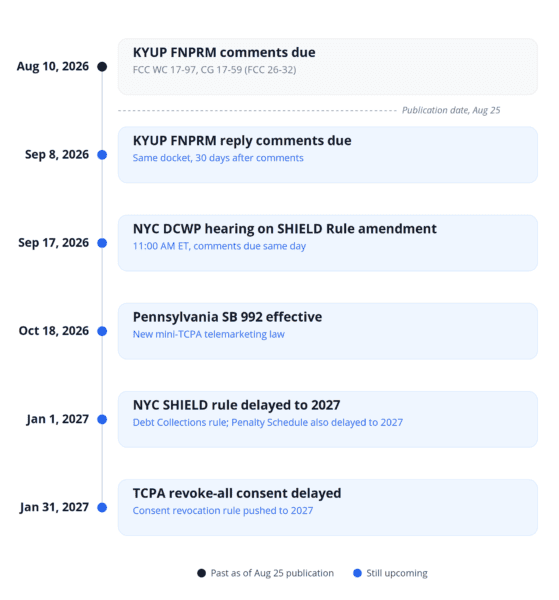
Mark Your Calendars
Foreign Robocall Elimination Act Passes Senate, Headed to House
Continued from the July 2026 regulatory report, which flagged this bill as one to watch.
The Foreign Robocall Elimination Act (S. 2666) passed the Senate on August 3, 2026, with an amendment by unanimous consent, and was held at the desk in the House as of August 10. Its House companion (H.R. 6152) now has 27 cosponsors. The most recent addition is Rep. Nicholas Langworthy (R-NY-23), who signed on August 20.
Industry response: The Broadband Association, applauded the Senate’s unanimous passage, with Josh Bercu, SVP of Policy at US Telecom, and Executive Director of the Industry Traceback Group, urging the House to “quickly pass the bill and send it to the President’s desk.” The bill also carries endorsements from AARP and cleared the Senate by unanimous consent, a rare outcome that itself signals the absence of significant industry pushback.
What the bill does: This bill creates an interagency task force, housed at the FCC and coordinated with the FTC and DOJ, to evaluate foreign-originated robocalls and develop strategies to combat them, drawing on experts across voice service, analytics, telecom, marketing, and consumer advocacy. It also introduces a new $100,000 provider bond requirement for registering in the FCC’s Robocall Mitigation Database.
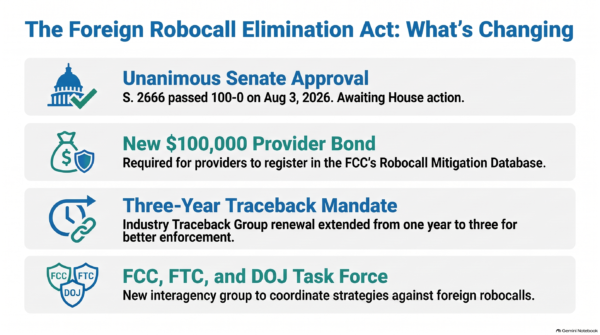
This is the first robocall bill the Senate has advanced since 2020, with AARP and USTelecom support. Cosponsorship on the House side is steady but not yet broad enough to signal imminent floor action. The two new provisions, which touch call-path verification and vendor registration, are worth tracking.
FCC’s “Revoke-All” Rule: The Clock Toward January 31, 2027
The FCC’s “revoke-all” requirement which treats a single opt-out, made through either a call or a text, as silencing all future calls and texts from that caller on any topic has been delayed twice already, now sitting at January 31, 2027.
The rule text itself (47 C.F.R. § 64.1200(a)(10)) says a valid revocation means “the caller may not send additional robocalls and robotexts,” so a single opt-out through either channel silences both.
The requirement covers two dimensions at once:
- Cross-topic: a STOP to one type of message (e.g. marketing) covers unrelated messages too (e.g. fraud alerts)
- Cross-channel: a revocation via text stops future calls too, and vice versa
That’s not stopping industry from pushing to change or kill the rule before it takes effect:
- ABA, NCLC, and ACA International jointly proposed revisions letting callers limit revocation scope to the message category involved, rather than an all-or-nothing cutoff. Their example: a customer who texts STOP to a marketing message could also lose fraud alerts from the same bank.
- The coalition went from written comments to in-person pressure, meeting FCC staff on July 21, then Chairman Carr’s senior counsel on July 27, asking for a 12-month runway if the rule is revised.
It’s the same kind of pressure that got the FCC’s one-to-one consent rule vacated before it ever took effect. Industry has pushed the FCC to go further than a delay and eliminate the rule entirely. Be mindful of the four other revocation obligations (10-day processing, expanded opt-out vocabulary, exempted-call treatment, and disclosure rules) which took effect in April 2025 and remain fully enforceable regardless of how this fight ends.
A ruling from this month shows the limits of that delay. In Zagury v. Puragain Water, No. 26-cv-20454-BLOOM/Elfenbein (S.D. Fla. Aug. 10, 2026), a court let a “stop”-to-calls claim proceed, not by applying the delayed cross-topic rule, but by pointing to a separate provision that’s been active since April 2024, predating the entire delay fight: “A caller who sends a one-time confirmation text after an opt-out must treat silence as a full revocation of both calls and texts.”
The delay industry won doesn’t close every path to the same result. The case now moves toward litigation on the merits, with Puragain required to answer the surviving TCPA and FTSA claims rather than continuing to seek dismissal.
Consent Cuts Both Ways: Florida Court Lets Fraud Counterclaim Proceed Against TCPA Plaintiff
A federal court just handed defendants a reminder that consent remains the key to the TCPA kingdom, and that plaintiffs who manufacture claims despite giving it can be countersued for saying otherwise.
In Smith v. GetMeHealthCare, LLC, No. 25-CV-00568 (M.D. Fla. July 21, 2026), the plaintiff alleged 31 unwanted telemarketing calls to a number on the national do-not-call registry. But during one of those calls, she stayed on the line, provided her name, address, date of birth, and insurance information, and completed enrollment in a health plan.
- GMHC didn’t just move to dismiss. It answered the complaint and countersued for fraudulent misrepresentation and inducement, arguing Smith’s own conduct contradicted her claims.
- The court agreed the counterclaim could proceed.
Robust consent documentation remains the strongest defense against TCPA exposure. When a caller’s own conduct shows willing engagement, that record, not just the initial opt-in, can be turned into an offensive tool, letting companies challenge plaintiffs who manufacture claims despite clear indicators of consent.
Consent, once given, doesn’t disappear because a plaintiff later claims otherwise. When call records show willing engagement, that record becomes offense, not just defense.
Quiet Hours Litigation: FCC Silence Meets a Court Ruling, and a Familiar Name Resurfaces
As we reported over a year ago in our April 2025 Regulatory Report, Ecommerce Innovation Alliance (EIA) filed a petition with the Federal Communications Commission (FCC) on March 3, 2025, asking the Commission:
- To confirm that consumers who give prior express written consent cannot sue under the Telephone Consumer Protection Act (TCPA) for messages sent outside the 8 a.m. to 9 p.m. “quiet-hours” window.
- To resolve the unworkable standard for determining a wireless recipient’s “local time.”
The FCC opened a comment period (closing April 25, 2025) but took no substantive action. By our May 2025 report, the National Consumer Law Center (NCLC) and allied consumer groups* had formally opposed the petition, arguing the existing rules are clear and that courts, not the FCC, should resolve these disputes. By August 2025, EIA was still working the issue through direct FCC engagement (an ex parte meeting on July 8, 2025), with the Commission having “not yet finalized its response or issued a formal ruling.”
For over a year, the underlying legal question sat unresolved at the regulatory level while the litigation volume it was meant to address kept growing.
What changed in 2026: on April 30, 2026, a federal court in Delaware ruled in King v. Bon Charge that consent defeats a quiet-hours claim, meaning a consumer who opted in to receive texts cannot turn around and sue over their timing.
- This is notable because the FCC never acted.
- EIA has framed the ruling as validating the position it argued unsuccessfully at the agency level for over a year, and legal commentators note it could serve as a “road map” for other courts facing the same question, potentially affecting settlement dynamics even without formal FCC guidance.
- It remains a single district court decision on a specific fact pattern, so its reach beyond that court is not yet established.
Litigant Watch: while King v. Bon Charge resolved the underlying legal question, a separate and more recent filing shows continued strain on the litigation model behind quiet-hours suits.
- EIA has tracked attorney Gerald D. Lane Jr. of the Law Offices of Jibrael S. Hindi, whose firm has brought more than 100 nearly identical cases, as one of the most active filers in this space.
- Per EIA’s analysis published on July 31, 2026, “Gerald Lane Forced to Acknowledge Under Oath That 145 Show-Cause Orders Have Been Issued in Central District of California; Judges in the District Then Issue Six More,” published July 31, 2026, Lane’s firm, one of the largest single sources of quiet-hours filings nationally, has now accumulated 145 show-cause orders in the U.S. District Court, Central District of California, for missed deadlines and procedural failures, with six more issued within days. This isn’t just noise: for every one of these cases, a real business is spending real time and legal fees responding, regardless of how the docket gets managed on the plaintiff’s side.
Why this matters: if your business already secures and documents prior express written consent before texting, King v. Bon Charge gives you a stronger basis to fight a quiet-hours claim rather than settle it, and it may support faster dismissal.
*Other consumer groups include Consumer Action, Consumer Federation of America, Electronic Privacy Information Center, National Consumers League, Public Knowledge, and U.S. PIRG.
Case Watch: TCPA, FDCPA, and Employment Litigation Roundup
RND Scrubbing, Straight From a Plaintiff’s Own Complaint
In Mitchelmore v. AdaptHealth Corp., No. 4:25-cv-03642 (S.D. Tex.), a Texas magistrate judge ordered AdaptHealth to map every wrong-number/wrong-person code across all its outbound campaigns, not just the one that called the plaintiff, finding that data goes directly to class certification and treble-damages exposure.
The complaint itself (¶ 41) literally states the following: “Had Defendants queried the [Reassigned Number Database (‘RND’)], they would have known not to call [Mitchelmore’s number].”
Wrong-number codes and flags are a record of harm that’s already occurred, which is useful for damage control after the fact, but an RND query happens before the call, preventing the underlying violation rather than just documenting it.
AdaptHealth also had to walk back a sworn declaration claiming certain wrong-number reports weren’t logged at all, then admitted the day before the hearing that they were.
$1.5M Settlement Shows What “Calls That Kept Coming” Actually Costs
Hiller v. The Money Source, Inc., No. 2:23-cv-00235-PHX-JJT (D. Ariz.), settled for $1.5 million, resolving TCPA claims that the mortgage lender kept placing prerecorded/artificial voice calls to consumers after they’d asked it to stop. The certified class covers everyone TMS called with a prerecorded voice after a stop request, as documented in TMS’s own business records, spanning February 6, 2019, through May 7, 2025 (four years before filing through the date of class certification). After fees, costs, and a service award to the named plaintiff are deducted, each class member is estimated to receive roughly $286 per call. TMS admitted no wrongdoing and disputes the claims. The settlement was signed June 2 to 10, 2026, with final approval still pending before Judge John J. Tuchi.
“We Buy Houses” Texts Aren’t Automatically Safe from TCPA Claims
The Ninth Circuit revived a TCPA suit in Coffey v. Fast Easy Offer, LLC, No. 25-4066 (9th Cir. June 4, 2026), reversing a district court that had dismissed the case on the theory that “want to sell your house?” messages aren’t solicitations since they don’t ask the recipient to buy anything.
The Ninth Circuit disagreed with that narrow reading: courts can look past the message’s literal wording to the sender’s alleged business purpose. Here:
- Plaintiff alleged most consumers who responded were funneled into paid brokerage services through an affiliated real estate company.
- The court found sufficient allegations to plead a “telephone solicitation” even though the text itself only offered to buy her home.
Lead generators and real estate-adjacent callers should take heed: a message’s surface wording isn’t a safe harbor if the underlying campaign is designed to generate customers for a paid service downstream.
Text and Hyperlink Can Satisfy FDCPA Validation Notice Requirements
A Florida federal court granted summary judgment for a debt collector, holding that a text message with a hyperlink to the full validation notice can satisfy the FDCPA’s disclosure requirement under 15 U.S.C. § 1692g(a), with no hard copy needed.
- The court found the initiating text sufficient because it named the collector, stated its purpose, identified the creditor, and linked to a single-click, zip-code-verified letter with the remaining required disclosures, distinguishing it from prior cases where hyperlinked notices required a “convoluted, multistep process” to access.
- The court also rejected a claim that phone disclosures were deficient, reasoning a consumer “cannot hang up on a debt collector who is behaving properly and then fault the debt collector for not disclosing information it would have disclosed if given a chance.”
- This debt collector had ceased all collection activity immediately upon learning the debt was disputed, a fact the court cited approvingly in finding no violation.
Four Unopened Emails Sink an Arbitration Agreement
The Ninth Circuit affirmed in Rickes v. Thermo Fisher Scientific that an employer’s arbitration agreement never bound an employee who simply never opened the four emails it was sent in.
The court held silence isn’t assent, and continued employment doesn’t retroactively create consent to a contract term the employee never saw.
Any business relying on email-only delivery for consent or contract terms, arbitration clauses, updated terms of service, or opt-in language should take note: if there’s no evidence the recipient actually opened it, a court may find there was never a binding agreement at all.
Robocall Volume Climbs for a Third Straight Month, Highest Level Since July 2025
U.S. consumers received just over 4.35 billion robocalls* in July, up from 4.25 billion in June and 4.1 billion in May, marking three consecutive months of growth and the highest monthly total since July 2025, according to the YouMail Robocall Index and YouMail’s own analysis of the data.
- Telemarketing and scam calls rose 5.7% to 2.13 billion, now accounting for 49% of all robocalls received in July.
- Wanted call categories declined: notifications fell 2.6% to 1.56 billion, and payment reminders dropped 1.2% to 630 million.
- The trend is well above its floor: monthly volume is now more than 15% above the low recorded in October 2025, even as the trailing 12-month total of 48.7 billion remains the lowest since September 2022.
- The dominant campaign centered on pre-approved personal loan offers, with scripts like “you’ve qualified for up to $45,000 with monthly payments around $575.”
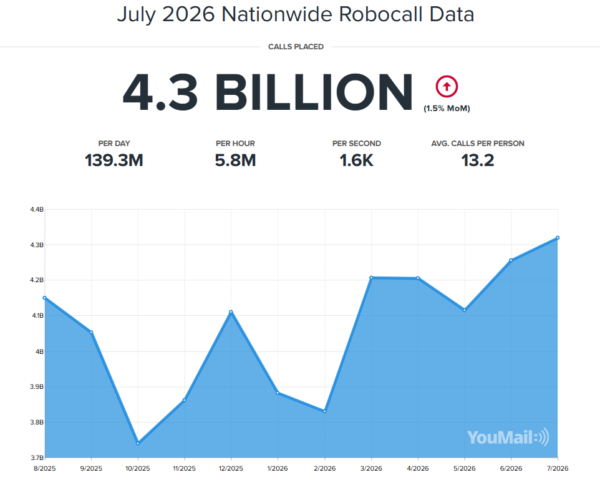
“Monthly robocall volumes have been slowly creeping upward, and we’re more than 15% above the lowest levels we saw last October,” said YouMail CEO Alex Quilici, who urged consumers to stay vigilant and use robocall-blocking tools.
*YouMail defines a robocall as any call detected through its network as being automated, using audio fingerprints, call-pattern analytics, and user reports, and includes both legitimate automated calls and illegal scam or telemarketing calls.
TCPA and CFPB Filings Pull Back From April Peak, Levels Remain Historically Elevated
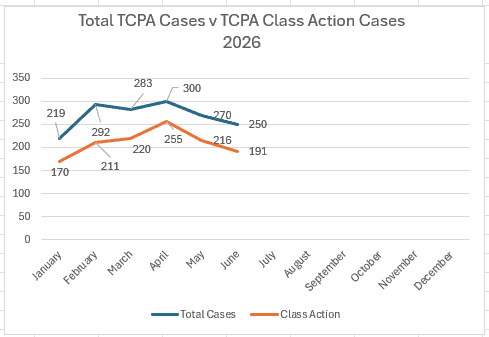
Six months into 2026, WebRecon’s June litigation data shows Telephone Consumer Protection Act (TCPA) filings and Consumer Financial Protection Bureau (CFPB) complaints pulling back from March and April highs, but two months of decline off a record peak is not the same as a return to normal. TCPA filings remain up 34.3% year-to-date and CFPB complaints 30.4%, and June’s totals are still well above where either metric started the year.
- TCPA total cases climbed from 219 in January to a high of 300 in April, then eased to 270 (May) and 250 (June), still 14% above January’s level.
- TCPA class actions followed the same arc, peaking at 255 in April before settling to 216 (May) and 191 (June).
CFPB complaint growth shows the same pattern: year-over-year gains ran 39 to 67% from January through March before moderating to 24% (April), 13% (May), and 11% (June), moderating growth, not declining volume. June’s 27,054 complaints still landed above every one of the first four months of the year except March.
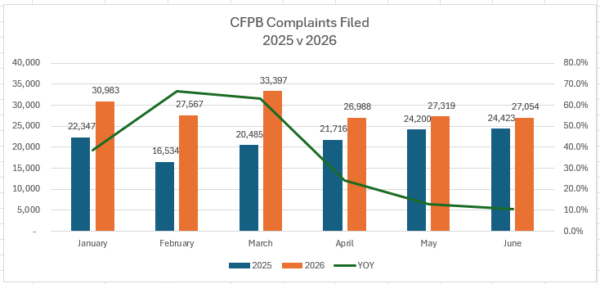
The underlying exposure hasn’t changed: TCPA class actions were still 76.4% of June’s TCPA filings, and roughly 40% of plaintiffs had sued before, a plaintiff bar that is active, repeat, and organized. A two-month pullback from a record spring surge is not a reprieve; it’s a plateau at levels still well above where 2026 began.
Fax Is Not Dead: FCC Revives Bid to Reconsider “Online Fax” TCPA Ruling (DA 26-862)
Six years after they were filed, three fax-related applications for review (AFRs) just got resurrected. On August 17, 2026, the Federal Communications Commission (FCC)’s Consumer and Governmental Affairs Bureau reinstated AFRs from Anderson + Wanca, Career Counseling Services, and Cin-Q Automobiles, all challenging the Bureau’s 2020 ruling that unsolicited fax ads sent to online fax services don’t violate the TCPA. Dismissed as “moot or outdated” in May 2026, the AFRs are now very much alive again after the petitioners showed they never got proper notice.
The literal fax machine may be a relic, but the regulatory apparatus built around it is not.
At issue is the Bureau’s 2020 “Amerifactors” ruling, which found that an ad sent to a fax server or similar online service isn’t sent to a “telephone facsimile machine” under the Telephone Consumer Protection Act (TCPA), putting online-fax traffic outside the statute’s reach entirely.
- That ruling has become a go-to defense in TCPA fax suits, and it’s the theory these AFRs are now asking the full Commission to revisit.
- Anderson + Wanca is one of the most active TCPA/junk-fax plaintiffs’ firms in the country, and Career Counseling’s underlying suit against Amerifactors is what produced the 2020 ruling in the first place.
Companies leaning on this online-fax carve-out for fax outreach should watch this closely, especially given the Commission is now reviewing the legal basis for that carve-out. The Bureau isn’t letting old objections lapse, worth tracking as a pattern across other pending dockets as well.
August 2026: FCC/FTC Semi-Annual Agendas Focus on Outbound Communications & GRC
The Federal Communications Commission (FCC) and the Federal Trade Commission (FTC) released their semi-annual regulatory agendas, listing dockets the agencies confirm are still open and under active internal review.
- These items should be on your watch list for the next six months despite quiet dockets.
- Even where the public docket shows no recent filing, its inclusion here means the agency has not closed or shelved it.
- The agenda is a sign that movement could still happen in this window; the issue is not dormant.
Direct relevance to outbound platform and compliance posture:
- AI-Generated Robocalls/Robotexts (FCC Docket 23-362): the only proceeding built around AI voice specifically. NPRM issued 9/10/24, comments closed 10/25/24, next action still undetermined. No movement in nearly two years, but its presence on this agenda confirms the FCC has not closed the docket. Highest-priority item to monitor for a follow-up NPRM or order.
- TCPA Implementing Rules (FCC Item 357): governs autodialer and prerecorded/artificial voice calls, core to outbound dialing compliance. The 2023 one-to-one consent rule (which would’ve required separate consent per seller) never took effect. It was vacated by the Eleventh Circuit and postponed by the FCC in January 2025, then formally removed by FCC order in November 2025. The prior standard (bundled consent across multiple sellers) governs today. Separately, the related “stop one means stop all” revocation rule remains delayed, most recently pushed to January 31, 2027, that’s the piece still worth tracking under this docket.
- Advanced Methods to Target/Eliminate Unlawful Robocalls (FCC Item 365): spoofing-based call blocking and reassigned number database, affects deliverability. Most recent action was an Eighth Report and Order on 3/24/25. The agency’s pattern here is incremental, sequential orders, so a Ninth is plausible in this cycle.
- Targeting and Eliminating Unlawful Text Messages (FCC Item 367): robotext-blocking framework for wireless carriers, the texting-side counterpart to Item 365. Relevant to any outbound SMS/text campaigns.
- Call Authentication Trust Anchor (FCC Item 458): listed at Final Rule stage. Most recent action was an NPRM (4/28/25) proposing non-IP caller ID authentication requirements; relevant if touching legacy telephony.
- Impersonation Rule (FTC, 16 CFR 461): flagged as having “some impact on small entities” in the FTC’s own review; relevant to AI-generated voice and brand impersonation risk across outbound campaigns.
No deadlines are triggered today. The value of this agenda isn’t recent activity, it’s confirmation that these five items remain formally live and warrant continued tracking in the near term.
Latest News on FCC KYC Mandates, NAAG Pushback, and Covered List Risk
The Federal Communications Commission (FCC)’s Know-Your-Customer (KYC) rulemaking, part of its ongoing effort to curb illegal robocalls, is drawing sharply opposed pressure from industry and state enforcers alike.
The new proposals tighten what originating voice service providers must verify before activating new customer lines.
- On July 29, the Consumer Access & Choice Coalition (CACC) filed reply comments urging the FCC to reject a one-size-fits-all mandate in favor of risk-based, behavior-driven rules, and to reject mandatory raw government-ID retention for ordinary consumers. CTIA, T-Mobile, TextNow, and Pinger all cited CACC’s filing in support.
- A day earlier, the opposite message arrived from state enforcers. A bipartisan coalition of 50 state and territory attorneys general, led by Illinois, Indiana, New Jersey, North Carolina, Ohio, and Pennsylvania, sent a formal letter to the FCC urging stronger, not weaker, KYC requirements to stop scammers from placing illegal robocalls, a message NAAG also amplified on LinkedIn. With industry and 50 AGs staking out opposite positions in the same week, the FCC’s next move on KYC is shaping up as a collision point.
FCC’s Covered List Risk for Outbound Compliance
The Federal Communications Commission (FCC)’s Covered List is becoming a carrier-level risk, not just a risk for equipment procurement, which matters for companies running outbound telemarketing or debt collection campaigns.
- Violations. The Commission has already cited Covered List and foreign-adversary ties to revoke Section 214 authority and pull providers from the Robocall Mitigation Database, most recently against China Unicom, China Mobile, and China Telecom affiliates.
- More regulation. A pending NPRM would go further, excluding Covered List entities from blanket Section 214 authority and their numbering resources outright. For campaigns that don’t originate their own traffic, that means an upstream carrier’s or CPaaS vendor’s Covered List exposure, not the telemarketer’s own Telephone Consumer Protection Act (TCPA) or Fair Debt Collections Practices Act (FDCPA) compliance, can cut off call and text origination without warning.
The equipment layer compounds this. A July 22 Third Report and Order closed the “component part loophole,” barring authorization for dialers, VoIP gateways, or contact-center hardware built on logic-bearing components from listed entities, narrowing the vendor pool for new procurement even though deployed equipment is unaffected. This means upstream carrier and vendor due diligence is now a business-continuity issue for outbound compliance programs, independent of calling-practice conduct rules.
CFPB Update: Complaint Data Publication Halted, Examiners Cautioned
Last month’s Regulatory Report covered the Consumer Financial Protection Bureau (CFPB)’s June 24 complaint portal overhaul, which added two-factor sign-up and required consumers to exhaust disputes with the credit reporting agency first.
The Bureau has now gone further on the same front:
- On August 14, it announced it will stop publishing unverified consumer complaint narratives and visualizations in its public database, calling the practice “entirely discretionary” and prone to presenting “misleading” one-sided data.
- Past narratives move to the Freedom of Information Act (FOIA) reading room.
- The Bureau will keep collecting, monitoring, and sharing complaint data with regulators internally; the public just won’t see the narrative text or visualizations anymore.
- Consumer advocates pushed back hard: NCLC, the National Association of Consumer Advocates, Consumer Federation of America, and Consumer Action jointly called it a retreat from transparency that shields “big banks, lenders, debt collectors, credit bureaus” from public scrutiny, while PIRG warned that nearly 6 million consumers who filed complaints received relief, a benefit it says the public database made possible.
- Industry groups took the opposite view: AFSA and NIADA welcomed the change, arguing unverified narratives had long created unwarranted reputational harm.
Separately, an internal email obtained by Reuters shows the Bureau’s own examination chief cautioning staff about the fallout from aggressive oversight.
In a May 13 email, Chief Examiner Fatima Batie told mid-level supervision staff that inflammatory or newsworthy remarks during exams would “come back to them unpleasantly,” tied to a new “humility pledge” requiring examiners to work “efficiently, transparently and collaboratively” with regulated firms. A former senior bureau counsel described it as a message that could make examiners hesitant to ask probing questions; examinations have already been cut roughly in half under acting leadership.
Quick Takes: NYC SHIELD Rule, NJ Data Broker Law, PA SB 992, and FCC Lifeline Action
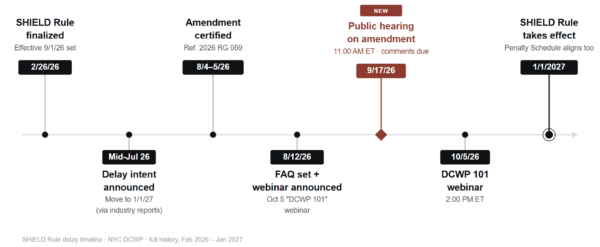
NYC’s Department of Consumer and Worker Protection (DCWP) has opened formal comments and scheduled a public hearing for September 17, 2026, on its proposed amendment moving the SHIELD Act debt collection rule’s effective date from September 1, 2026, to January 1, 2027.
- As flagged in Gryphon’s Regulatory Report: July 2026, the delay follows industry requests for more implementation time and gives DCWP room to address open questions before enforcement begins.
- Written comments are due the same day as the hearing (11:00 AM ET).
- DCWP published FAQs confirming the January 1, 2027 effective date and clarifying scope. Key points from the official FAQ document: the “3×7” contact limit applies to all NYC accounts regardless of purchase date; litigation-related communications fall outside the rule entirely; and new verification obligations attach only to accounts where a validation notice is required on or after January 1, 2027.
- Note: on August 20, the Debt Collector Penalty Schedule, originally effective September 1, 2026, was also postponed to January 1, 2027.
New Jersey’s Data Broker Law (A5328)
New Jersey enacted the nation’s most aggressive data broker law on June 30, 2026, just two days after introduction. Registration fees run up to $1.5 million, 250 times California’s prior high-water mark, and the law uniquely reaches “data collectors” selling data gathered from their own customers. Regulators paused registration and fees until the registry launches (window: April 1 to June 30, 2027), but the sensitive-data sales ban took effect immediately, carrying $50,000-per-record penalties.
The urgency tracks a real credibility gap: California brokers have denied or ignored over a million deletion requests in two years, and Washington’s AG just flagged “opaque data-broker practices” as a top statewide concern. Don’t treat NJ’s law as a 2027 problem; the sales ban is enforceable now.
Pennsylvania’s SB 992 Effective Date Approaching (October 18)
A reminder as the clock runs down: Pennsylvania’s amended telemarketing law, SB 992, takes effect October 18, 2026. See our July report; four points worth flagging again:
- Calling windows narrow to 9:00 AM to 7:00 PM, with no solicitations permitted on Sundays at all.
- Telemarketer registration provisions are reorganized, with a new exemption for callers whose messages don’t meet the “telephone solicitation” definition. Don’t assume your current registration status still applies without re-checking.
- PEWC must now be a signed agreement (electronic OK) that specifies the phone number covered, discloses that consent isn’t a condition of purchase, and states the subscriber agrees to receive solicitations, including robocalls or texts.
- Confirm calling windows, registration status, and consent language are all updated before the effective date.
FCC Blocks Lifeline Provider From Enrolling Any New Customers
The FCC barred IM Telecom, one of the largest Lifeline subsidy recipients, from enrolling any new subscribers on July 27, 2026, citing unconsented subscriber transfers, a scheme to dodge non-usage rules, and an unapproved change in corporate control. IM Telecom has drawn over $262 million in federal Lifeline funds since 2024; federal agents executed search warrants on individuals tied to the company that same month, and California and Oregon separately issued cease-and-desist letters. Existing customers can still switch providers, but IM Telecom can’t add new ones while the FCC weighs further action.
Update: IM Telecom’s majority owner, KonaTel, disclosed on August 13 that it disputes the FCC’s allegations and will respond directly, an unresolved fight worth tracking given KonaTel’s pending sale of the subsidiary to Excess Telecom, the same deal the FCC flagged as never having received required approval.
September Holiday Telephone Solicitation Bans
Please be aware of the following U.S. holiday telephone solicitation bans for the month of September 2026:
- On September 7th, 2026, Alabama, Louisiana, Nebraska*, Pennsylvania, Rhode Island, Utah prohibit unsolicited sales and marketing calls to residents in observance of Labor Day.
Other holidays may be proclaimed by the Governor in each state throughout the year.
Please be aware of the following Canadian holiday telephone solicitation bans for the month of September 2026:
- On September 7th, 2026, unsolicited sales and marketing calls to residents of all provinces and territories are prohibited in observance of Labour Day.
- On September 30th, 2026, unsolicited sales and marketing calls to residents of the following provinces and territories are prohibited in observance of National Day for Truth and Reconciliation: British Columbia, Manitoba, Northwest Territories, Nunavut, Prince Edward Island, and Yukon.
Gryphon has updated its existing service parameters to reflect these solicitation bans. Please contact us with any questions at 866-366-6822.
*Nebraska does not prohibit calls on Sundays or legal holidays; however, it does restrict the use of prerecorded messages between 1pm to 9pm on these days (subject to certain exceptions).
New York State of Emergency Issued through September 13, 2026
Consistent with prior communications, Executive Orders declaring disaster emergencies in the State of New York trigger telemarketing restrictions under the Nuisance Call Act.
The Nuisance Call Act makes it unlawful for any telemarketer to make unsolicited telemarketing sales calls to areas of the state under an emergency declaration.
Executive Order 47.21 declaring a State Disaster Emergency in the State of New York ordering into active service the New York national guard to assist authorities in guaranteeing public order (correctional facilities), is in effect through September 13, 2026.
Gryphon has extended State of Emergency blocks for New York to September 13, 2026, to ensure compliance with the above Executive Orders.
Contact the Gryphon Helpdesk with any questions at 866-366-6822.
About Gryphon
Staying updated with the latest regulatory changes is crucial for any enterprise aiming to minimize risk and maximize reach.
With Gryphon, enterprises can stay ahead of the regulatory curve and efficiently manage all regulatory changes, ensuring seamless compliance and operational excellence.
To learn more about how Gryphon can help you manage these updates, reach out to us today.
This blog is provided for general informational and marketing purposes only and does not constitute legal advice. The information may reflect an interpretation of applicable laws and regulations as of the publication date and may not reflect subsequent changes. Laws and regulations vary by jurisdiction, and this content may not apply to your specific circumstances. Nothing in this blog should be relied upon as a substitute for legal advice, and we disclaim any liability for actions taken based on the content provided. Please consult qualified legal counsel for advice specific to your situation.