

September brought a wave of activity across every level of the regulatory landscape: a major FCC reversal on “revoke all” consent, an expanded overhaul of the Robocall Mitigation Database, a sweeping CFPB reform bill, new state telemarketing laws in Pennsylvania and North Carolina, and a fresh batch of TCPA rulings that keep splitting courts on whether texts count as calls. Compliance teams have a lot to track this month, and a few items carry hard deadlines worth flagging now.
Reminders
State Watch
PA SB 992, Reminder, Effective October 18, 2026
See previous Gryphon Regulatory Reports for July and August for more detail on Pennsylvania SB 992.
- Calling windows narrow to 9 AM to 7 PM, with no Sunday solicitations.
- Prior express written consent must be a signed, TCPA-aligned agreement.
- Registration provisions are reorganized, with a new exemption for callers whose messages don’t meet the “telephone solicitation” definition. Don’t assume your current registration status still applies without re-checking.
NC SB 445, Effective December 1, 2026
North Carolina‘s omnibus “Regulatory Reform Act of 2026” (S.L. 2026-59), signed August 11, includes Section 20, which tightens telephone solicitor rules effective December 1.
- Agents and call centers dialing on a client’s behalf are now independently liable as “telephone solicitors” (agents now directly exposed).
- Recordkeeping duty shifts solely to the solicitor. Clients can no longer point to a vendor as responsible.
- The caller ID standard also loosens from “misrepresent” to any display alteration creating a false perception of origin, though the branded-display safe harbor and caller ID provider shield both carry forward unchanged.
- Knowing spoofing violations now carry a steep $10,000 per-call penalty, stacked on top of existing tiers.
Federal Regulation Updates
FCC’s “Revoke All” Reversal: New Rules Favor Industry Flexibility
The Federal Communications Commission (FCC)’s September 9 draft Report and Order/FNPRM (CG Docket 02-278) walks back the categorical revoke-all approach before it ever takes effect. The FCC’s 2024 order already contains a “revoke all” rule under which a consumer’s “STOP” to a payment reminder would also silence fraud alerts, appointment reminders, and other messages they may still want, but that provision has been delayed twice and isn’t set to take effect until January 31, 2027. The new draft replaces it before it kicks in. Scheduled for the September 30 open meeting, the Order:
- Allows callers to treat a revocation directed at one category of informational robocall as limited to that category.
- Marketing revocation remains all-or-nothing: an opt-out from one ad or telemarketing message still kills all future marketing from that caller.
The bigger win: callers can now designate an exclusive revocation method (IVR/keypress, standardized reply-text keywords like “STOP,” or a caller-provided website/number) and ignore opt-outs made any other way, so long as the method is clearly disclosed.
- Companies that skip designating a method stay on the older “reasonable means” standard.
The FCC itself notes the designated-method approach lets companies automate opt-out processing and cuts down on manual review. The rule also loosens the financial-institution fraud-alert exemption to cover numbers from “reliable sources” (spouse, family member, another institution’s records), not just numbers the customer gave directly.
Industry pushed hard for this:
- Edison Electric Institute (EEI):
- Their ex parte specifically asked that a customer’s revocation not apply to legally required utility communications unless directed at them, and the FCC agreed.
- EEI also asked the FCC to let callers send a one-time confirmation message stating the scope of a revocation (e.g., “opted out of billing alerts, not outage notices”). If the customer doesn’t respond, the revocation is locked in at that stated scope rather than defaulting to everything. This lines up with the category-specific default the FCC adopted.
- Twilio, ECAC, and USTelecom all argued the old any-reasonable-method standard created costly, unworkable compliance burdens; the FCC cited them directly in adopting the exclusive-method rule.
- See also CommLaw Group’s operational breakdown.
None of this is final yet, it’s a draft, subject to change until the September 30 vote. If adopted as written, it takes effect 30 days after Federal Register publication, superseding the delayed January 31, 2027 effective date on revoke-all.
The accompanying FNPRM opens a second front:
- Comments are sought on cutting the 10-business-day revocation window to 7.
- Mandating two-way texting for reply-based opt-outs.
- Requiring a one-step “revoke all” option.
- Clarifying how revocation applies across affiliates and business lines.
The Joint Letter from ABA, NCLC, and ACA International drove much of this. Comments are due 30 days after Federal Register publication, replies 60 days after.
RMD Reform and Associated Enforcement
The FCC issued a sweeping Robocall Mitigation Database (RMD) overhaul FNPRM (WC Docket 24-213/17-97, CG Docket 17-59).
- Published in Federal Register: September 9
- Comments due: October 9
- Reply comments due: November 9
The new FNPRM would:
- Expand who must file (VoIP resellers, MVNOs, call centers, cloud platforms, regardless of whether they hold a traditional FCC authorization).
- Require parents, affiliates, and subsidiaries to file separately.
- Add sweeping new certifications (24-hour traceback response, no false info to the ITG, NANPA, or STIR/SHAKEN Governance Authority).
- Demand far more ownership and principal disclosure.
- Let the FCC hold new filings in pending status before they take effect.
- Create an expedited 5-day-to-cure removal process for serious violations.
Pinger argued attestation decisions should stay with providers who hold their own SPC token and know the customer directly: “every attestation decision for Pinger traffic is made by Pinger… executed with Pinger’s credentials.” Meanwhile, TextNow’s reply comments (filed September 8 by COO Lindsay Gibson) argued the rules should turn on what a provider actually does, not the label it’s assigned: “The Commission should not adopt a description of a category as a classification of every provider in it… the definition should be applied to what each provider does rather than to the category label it carries.”
This carries immediate consequence.
- On September 2, the FCC’s Enforcement Bureau removed 14 voice service providers from the RMD after they failed to cure deficient certifications following show-cause orders. All U.S. voice service and intermediate providers had two days to begin blocking traffic from these 14, a real, fast-moving compliance obligation for anyone accepting inbound traffic.
- Chairman Carr paired the removals with a proposed Robocall Mitigation Scorecard that would publicly grade retail wireless, wireline, and VoIP providers (not wholesale or intermediate) on both conduct (blocking tools offered, traceback responsiveness) and outcomes (complaints, calls blocked, false-positive rate).
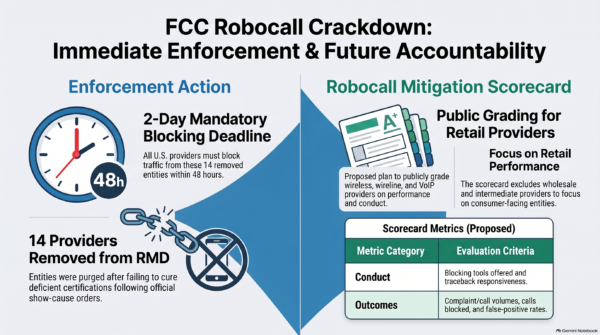
The scorecard isn’t a rulemaking and won’t itself create new compliance obligations, but it signals where enforcement priorities are headed: an accurate, complete RMD filing is now a condition of staying connected to U.S. networks, not a paperwork exercise.
CFPB Overhaul
On September 16, the House Financial Services Committee marked up H.R. 10184, the Consumer Financial Protection Accountability and Reform Act of 2026. Introduced on August 31 by Reps. Andy Barr and Chairman French Hill, the bill would change how the CFPB is funded and run, and rein in its rulemaking and enforcement powers.
Following the September 16 markup, here’s what the bill would do:
- Fund the CFPB through congressional appropriations instead of directly from the Federal Reserve.
- Create a new, independently confirmed CFPB watchdog.
- Have the White House budget office, not the CFPB, periodically review major rules against a “net-benefits” test: every 8 years for major rules, every 10 for others.
- Raise the bar for what counts as an “abusive” practice under the law.
- Triple the asset threshold ($10 billion to $30 billion) before a bank or credit union falls under direct CFPB supervision.
- Give companies a break on penalties if they made a good-faith effort to comply.
- Stop state attorneys general from piling onto a case the CFPB is already pursuing.
The bill would also bar using UDAAP claims to bring discrimination allegations and requires a Government Accountability Office (GAO) study of buy-now-pay-later products.
- The American Bankers Association (ABA) specifically praised the $30 billion threshold as consistent with recent, independent threshold determinations by the FDIC and OCC.
- Chairman Hill has framed the bill’s purpose consistently: at a September 1 roundtable, he argued that an agency a future director can reverse with a stroke of a pen creates wild swings in policy that are bad for consumer lenders and the economy, and at the September 16 markup he called the bill a set of durable guardrails meant to make the CFPB more accountable and transparent while keeping its focus on protecting consumers.
ACA International has pushed for the bill, arguing bureau instability is itself a driver of over-regulation and consumer cost; a September 1 roundtable with Barr, Hill, and industry executives fed directly into the current draft.
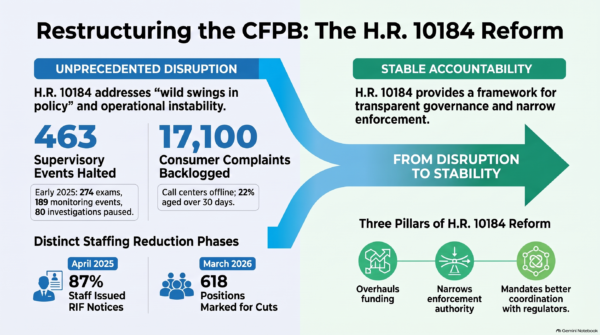
A joint Office of Inspector General (OIG) report from the Fed and CFPB, requested by Congress and released in late August, found that in early 2025 the bureau halted 463 supervisory events (274 exams, 189 monitoring events) and paused 80 investigations. From February 2025 to January 2026 it dismissed 18 pending cases and withdrew from another. Of 525 active contracts, 91 were canceled and 204 allowed to expire. A termination notice to the complaint-database contractor left complaints unrouted for two-plus weeks and the call center offline for a day, feeding a backlog of roughly 17,100 complaints as of June 2026, 22% of it aged over 30 days. The bureau dismissed 182 probationary/term employees before courts ordered reinstatement, and issued RIF notices to 87% of staff before an injunction; a March 2026 plan called for cutting 618 positions. Litigation over the RIF is partially stayed until a new director is confirmed or January 4, 2027, whichever comes first.
Foreign Robocall Elimination Act (H.R. 6152)
This bill would direct the FCC to set up a task force to study robocalls coming from overseas and report its findings to Congress. It would also let the FCC require a bond of up to $100,000 before a company can register in the Robocall Mitigation Database, if the agency decides that’s needed to keep bad actors out.
Support has surged in recent weeks. The bill now has 38 cosponsors (21 Republicans and 17 Democrats), up from 3 at introduction in November 2025, with 11 joining since August 20 alone.
On September 16, the full House Energy and Commerce Committee ordered the bill reported by a unanimous 37-0 recorded vote, following a September 1 voice vote in the Communications and Technology Subcommittee. The bill now awaits action by the full House.
The Senate companion, S. 2666, passed the full Senate by unanimous consent on August 3 (with an amendment) and is being held at the desk in the House (see our August 2026 Regulatory Report for more). It goes further: the bond and RMD registration would be mandatory, not optional, before a company can send calls into the U.S.
USTelecom and AARP have backed the Senate bill.
Foreign Call Traffic: FCC Warns RGTN USA
On August 24, the FCC’s Enforcement Bureau sent RGTN USA a Notification of Suspected Illegal Traffic after tracing spoofed and fraudulent calls, impersonating local police, CBP, and major banks/retailers, plus swatting calls, back through foreign originator GUGU and intermediate carrier SwissXperts to RGTN’s U.S. gateway.
- RGTN has 48 hours to respond and report its mitigation steps; failure to act lets downstream providers permanently block all RGTN traffic under the Section 64.1200(k)(4) safe harbor, with no liability for doing so.
- Any client accepting traffic that transits RGTN should confirm KYUP diligence covers this exposure.
FCC Covered List Fines
On August 27, the FCC proposed a $188,491 fine against Hytera Communications and ZTE for failing to timely submit required contact information for Covered List subsidiaries and affiliates. It’s a reminder that Covered List compliance extends beyond the named entities to their corporate family, and that reporting failures alone (not just equipment sales) draw enforcement.
Quick Takes
H.R. 10310, “The Robo COP Act”
Rep. Virginia Foxx (R-NC) introduced H.R. 10310, the “Robo Calls Off Phones Act” or “Robo COP Act,” on September 8. If enacted, the Federal Trade Commission (FTC) would have 180 days to revise the Telemarketing Sales Rule (TSR)’s do-not-call (DNC) registry provisions to prohibit “politically-oriented recorded message telephone calls” to any number on the National DNC Registry.
The bill defines a covered call as: any outbound call where a person isn’t available and a recorded message plays instead, if it promotes, advertises, campaigns for, or solicits donations for or against a candidate or issue, or names a candidate.
This isn’t Foxx’s first attempt. Versions of the Robo COP Act have been introduced in five prior Congresses since 2015 without passing; opponents have argued a political-calls carve-out from DNC protections raises First Amendment concerns given political speech’s heightened protection.
Political waivers? The bill arrives as the opposite argument is being pressed at the Federal Communications Commission (FCC).
- Club for Growth, a conservative political advocacy group, filed a petition August 31 asking the FCC to exempt AI-generated political robocalls to cell phones from the Telephone Consumer Protection Act (TCPA)’s prior-consent requirement ahead of the November midterms, the same treatment already given to political calls made to residential landlines.
- The FCC opened a comment period September 4 (comments due October 5, replies October 19).
- Robo COP tightens political-call rules on the DNC side; the Club for Growth petition loosens them on the cell-phone/AI side. Both target the same underlying gap, political calls’ exemption from ordinary telemarketing consent rules, from opposite directions.
FTC Launches Rule Guidance Program to Clarify Regulatory Gray Areas
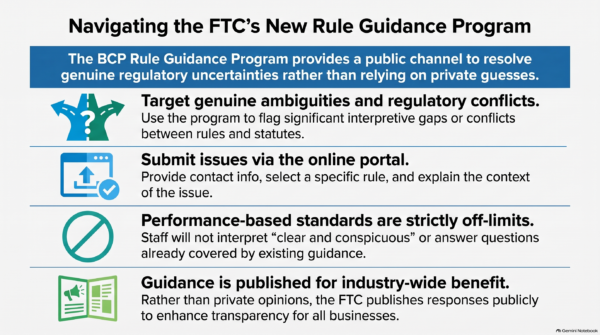
The FTC’s Bureau of Consumer Protection launched a new BCP Rule Guidance Program on September 10, giving businesses and industry groups a formal channel to flag:
- Genuine ambiguities in FTC rules.
- Conflicts between a rule and a statute.
- Other significant interpretive gaps.
Stakeholders submit questions through an online form; BCP staff review and, if warranted, publish the guidance publicly so the whole industry benefits, rather than issuing private advisory opinions.
The program has real guardrails:
- BCP won’t answer questions that just ask staff to restate a rule, or that appear designed to help a business sidestep its own compliance obligations.
- Performance-based standards with established case-law meaning, like “clear and conspicuous,” are also off-limits; those still require your own legal judgment applied to your specific facts.
- Questions already answered by the FTC’s existing plain-language guidance won’t get a response either.
For telemarketing and debt collection compliance teams navigating ambiguous corners of the Telemarketing Sales Rule, FDCPA, or GLBA Safeguards Rule, this is a real avenue worth using: a genuine gray-area question with no clear answer in existing guidance could get you, and everyone else watching the published responses, an authoritative answer instead of a guess.
Submit through the program webpage, which also links to existing FTC rules, plain-language guidance, and formal advisory opinions.
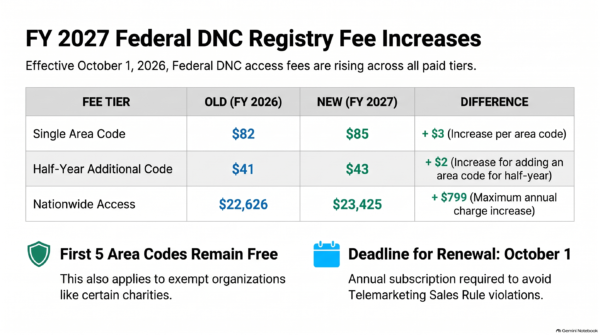
Increased Federal DNC Fees, Effective 10/1/2026
Effective October 1, telemarketers will pay more to access the National Do Not Call Registry for FY2027. The FTC announced the single-area-code fee rises to $85 (up $3 from FY2026), the half-year additional-area-code fee rises to $43 (up from $41), and the maximum charge for full nationwide access rises to $23,425 (up from $22,626). The first five area codes remain free, and exempt organizations (certain charities, political callers) can still access the full registry at no cost.
All telemarketers calling U.S. consumers must subscribe annually for registry access; missing the October 1 renewal risks calling numbers you’re not authorized to have downloaded, a Telemarketing Sales Rule violation independent of any TCPA exposure.
NY Telecom Faces Potential Traffic Blocking, FCC Warns
On August 24, the FCC’s Enforcement Bureau issued a Notification of Suspected Illegal Traffic to New York-based gateway provider RGTN USA after finding that RGTN allegedly carried fraudulent foreign-originated calls onto U.S. networks. The traffic reportedly originated with Swiss provider TheSwissXperts AG and included spoofed calls impersonating banks, law enforcement, CBP, Amazon, Coinbase, and Walmart, as well as swatting calls. Receivables Info’s case summary provides additional detail on the FCC’s allegations and compliance deadlines.
RGTN was directed to:
- Within 48 hours: mitigate the identified traffic and notify the FCC/ITG of its steps.
- Within 14 days: investigate the traffic, block or cease accepting illegal or substantially similar traffic as appropriate, and report its findings to the FCC.
- Within 14 days: implement measures to prevent new and renewing customers from originating illegal calls.
If RGTN does not comply, the FCC may issue an Initial Determination Order, giving RGTN an opportunity to respond before a potential Final Determination Order. A final order could require downstream providers to block all RGTN traffic. The FCC also identified potential Robocall Mitigation Database removal, which would separately bar providers from accepting RGTN traffic. The matter underscores the FCC’s continuing scrutiny of gateway providers handling foreign-originated call traffic.
August NAAG Robocall Summit: Highlights
State AGs, industry, and the FCC convened for the 2026 NAAG Robocall Summit on August 19-20.
Two themes dominated:
- Know-Your-Customer/Know-Your-Upstream-Provider standards, where industry pushed back on one-size-fits-all vetting mandates while 50 state AGs had just urged the FCC, in comments filed days earlier, to adopt robust KYC rules.
- STIR/SHAKEN data, where panelists debated whether the FCC’s push for “more directed oversight” of STIR/SHAKEN governance would meaningfully curb fraud or just add friction.
TransNexus and NCLC were among the industry and consumer voices cited in the broader KYC record referenced at the summit:
- TransNexus data shows a small number of providers still originate most problematic traffic.
- NCLC has argued a bad reputation alone hasn’t stopped repeat offenders from reaching consumers.
Expect continued state-level pressure regardless of how the FCC’s pending rulemakings land.
New FCC Enforcement Bureau Chief
Chairman Carr announced Hunter Deeley as the new Chief of the FCC’s Enforcement Bureau on August 31, succeeding Patrick Webre, who moves to a senior role in the Office of Managing Director.
Deeley was previously the Bureau’s Chief of Staff and Deputy Chief, where he supervised enforcement matters touching national security, working closely with the Intelligence Community and law enforcement partners.
Before the FCC, he was at DOJ’s National Security Division handling CFIUS and Team Telecom matters, and served as a Special Assistant U.S. Attorney in D.C.
Carr’s statement ties the appointment directly to “robocall enforcement” and “rooting out fraud” alongside national-security work, worth noting given the Enforcement Bureau’s expanding role across RMD removals, KYUP compliance, and foreign-traffic warning letters.
Case Watch
AI Robocalls, TCPA, and Texas Converge in Class Action
A new class action lawsuit targets three law firms that used AI-generated voices to cold-call potential mass-tort clients. The plaintiff says she told the AI agent “no” multiple times, never consented, and it kept pitching anyway. She’s suing under four theories: the TCPA (the FCC treats AI-cloned voices as “artificial voice”), Texas’s mini-TCPA, Texas’s telephone-solicitor registration statute, and a Texas law barring attorneys from soliciting legal employment by phone. The case is still pending, but it’s a reminder plaintiffs’ counsel are stacking state law on top of TCPA claims for AI voice campaigns.
Cell Phones Are Not “Residential” Lines?
In Anthony v. Brian Marketing Group (S.D. Fla. Sept. 11, 2026), Judge Aileen Cannon refused to enter default judgment on a DNC claim, holding the FCC overstepped when it redefined “residential telephone subscriber” to include cell phones, since the statute only covers “residential” subscribers. Most courts disagree with her. In McGonigle v. Dickey’s Barbecue Restaurants (E.D. Va. July 22, 2026), the court went the other way, finding a cell phone can count as “residential” if it’s used mainly for personal, household stuff, pointing to the FCC’s own view that most people today only have a cell line anyway. Cannon’s opinion breaks from that majority approach, worth watching.
Debt Collector Contact After Opt-Out
A Pennsylvania federal court granted summary judgment for a consumer class, finding a debt collector’s continued texts after an opt-out request violated the FDCPA, a reminder that an opt-out on one channel needs to be honored consistently, whether the next contact comes by text or email.
7-in-7 Violation, By the Numbers
A California class action, Teasley v. Sunrun Inc., accuses a creditor of violating Reg F’s call-frequency limit: no more than seven calls to a consumer within seven consecutive days. The complaint says eight calls went out over a ten-day span (Feb. 3 to Feb. 12). But the complaint’s own exhibit undercuts the claim: the busiest possible 7-day window (Feb. 6-12) shows exactly seven calls, not more than seven. Reg F only bars more than seven within seven days, so on the plaintiff’s own numbers, no single week actually crosses the line; the eighth call only shows up if you stretch the window to ten days, which isn’t the rule. Good one to flag for teams pulling call logs: the frequency count only matters within a rolling 7-day window, not the total span of contact.
Do Texts = Calls?
The Seventh Circuit’s Steidinger ruling (texts aren’t “telephone calls” under TCPA Section 227(c)(5)) is spreading, but it’s certainly not settled, including within the Fourth Circuit itself. Judge Eagles in the Middle District of North Carolina followed Steidinger’s reasoning in Card v. R.J. Reynolds Tobacco Holdings, Inc. (M.D.N.C., Sept. 3, 2026), holding texts fall outside Section 227(c)(5). But that’s not the first word from the Fourth Circuit on this: back in January, a court in the Northern District of West Virginia went the other way in Mey v. Liberty Home Guard, LLC (Jan. 5, 2026), holding texts do fall within Section 227(c)(5). Card and Mey directly conflict, so the Fourth Circuit has its own internal split before you even get to the broader circuit-level disagreement. Commentators say Steidinger should still strengthen responses to presuit demand letters and early-stage DNC-text claims, but with district courts pointing different directions even within the same circuit, this is far from resolved.
See the interactive Gryphon Judicial Ruling Tracker for ongoing updates on this topic.
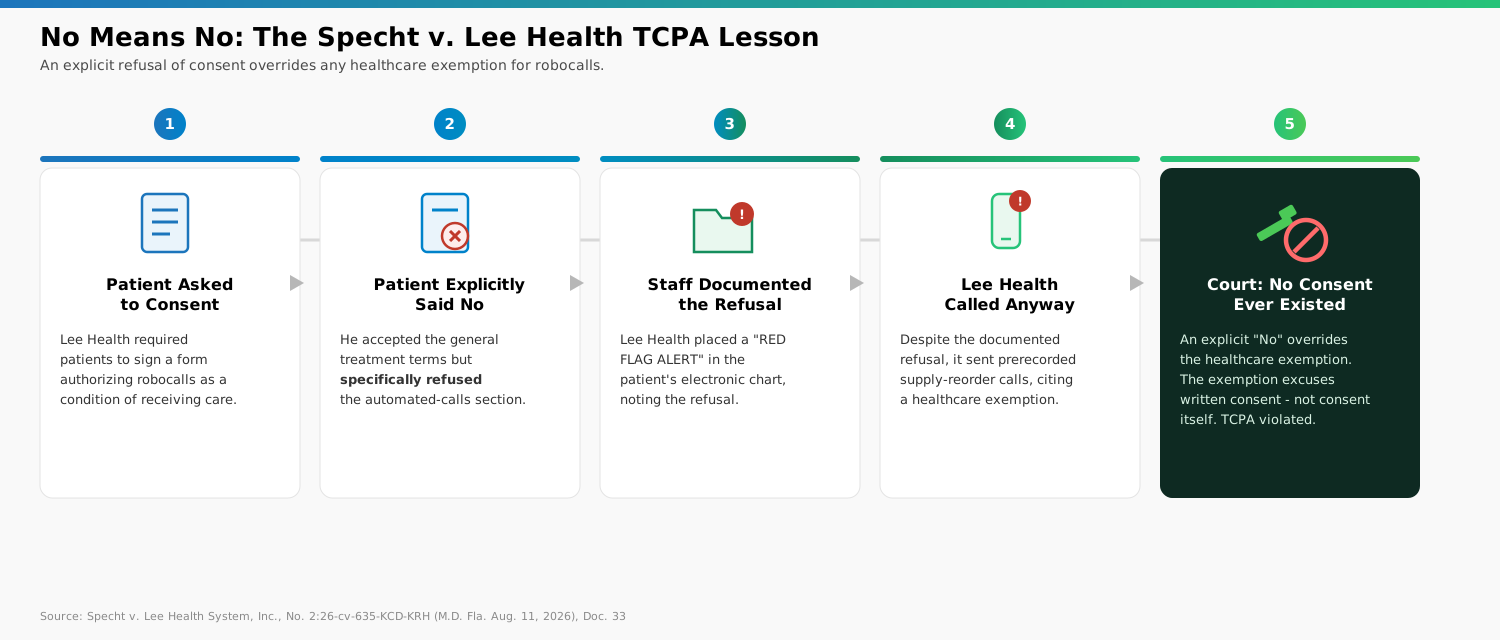
Specht v. Lee Health System, Healthcare Exemption Trap
Specht was allegedly denied hospital service and escorted out by security after refusing to sign a treatment form that included a TCPA consent clause. The hospital’s post-visit “prescription notification” robocalls were exempt under the FCC’s TCPA healthcare exemptions on their own; Lee Health never needed Specht’s consent to begin with. But by offering the consent form anyway, the court found Lee Health gave Specht a chance to opt out, and his refusal to sign counted as exactly that: a revocation. Lesson for healthcare callers: don’t ask for consent you don’t need. Offering a superfluous consent form can hand a plaintiff a revocation argument where none existed before.
Industry Take: TCPA and DNC Best Practices
National Consumer Law Center (NCLC) senior attorney Patrick Crotty’s latest analysis lays out just how unsettled TCPA law has become post-McLaughlin:
- The Seventh Circuit says texts aren’t “telephone calls” for DNC purposes (Steidinger).
- The Fifth Circuit just invalidated the FCC’s written-consent requirement entirely (Bradford v. Sovereign Pest Control).
- Courts are increasingly willing to second-guess FCC interpretations they once treated as binding.
Crotty’s own conclusion, though, cuts the other way for careful callers: on cell phones, the presumption that a registered number is “residential” still stands; the Ninth Circuit’s test for rebutting it (business registration, business use, who pays the bill, DNC registration) puts the burden on the defendant, not the consumer.
Crotty’s piece also flags a growing risk on the consent side: courts are getting more skeptical of thin “digital consent” evidence. The “great weight of authority,” including the Second, Third, Sixth, Ninth, and Eleventh Circuits, still treats texts as calls, and Crotty notes Congress’s own 2019 TRACED Act only makes sense if texts count as calls, since it requires information-sharing on “a call made or a text message sent” under the DNC provision.
He lists four things that can defeat a business’s claim that a website visitor consented to calls:
- It wasn’t actually the consumer who visited the site.
- The consent language wasn’t on the page at the time of the visit.
- The visitor’s actions didn’t clearly indicate consent.
- The link to the consent language wasn’t conspicuous.
His practical tip for verifying the second point: check the Internet Archive’s Wayback Machine against the date in question, since at least one court has already caught a business producing the wrong version of its own site.
Klein Moynihan Turco’s recent post makes the compliance case even simpler. A written internal DNC policy isn’t just good practice, it’s actually required under the TCPA’s implementing regulations:
- A written policy.
- Trained personnel.
- Documented DNC requests.
- Honored within 10 business days.
Maintain all four elements and you have an affirmative defense to DNC claims (though not to autodialer or prerecorded-voice claims, which fall under separate rules). Skip any piece and that defense disappears.
Together, a plaintiff-side scholar and a defense firm are making the same point: what counts as a “call,” as consent, or as a protected number keeps shifting, but a documented, trained, consistently honored DNC policy holds up regardless of circuit or how McLaughlin-era courts break.
Whatever the circuits eventually decide on the harder questions, best DNC practice remains the safest bet, and the one Gryphon will always recommend first.
October 2026 Holiday Solicitation Bans
Please be aware of the following U.S. holiday telephone solicitation bans for the month of October 2026:
- On October 12, 2026, Alabama, Nebraska*, Pennsylvania, Rhode Island, and Utah prohibit unsolicited sales and marketing calls to residents in observance of Columbus Day (also referred to as American Indian Heritage Day or Indigenous Peoples’ Day).
Other holidays may be proclaimed by the Governor in each state throughout the year.
*Nebraska does not prohibit calls on Sundays or legal holidays; however, it does restrict the use of prerecorded messages to 1pm to 9pm on these days (subject to certain exceptions).
Please be aware of the following Canadian holiday telephone solicitation bans for the month of October 2026:
- On October 12, 2026, unsolicited sales and marketing calls to residents of the following provinces and territories are prohibited in observance of Thanksgiving Day: Alberta, British Columbia, Manitoba, Northwest Territories, Nunavut, Ontario, Quebec, Saskatchewan, and Yukon.
Gryphon has updated its existing service parameters to reflect these solicitation bans. Please contact us with any questions at 866-366-6822.
State of Emergency Updates
New York: Consistent with prior communications, Executive Orders declaring disaster emergencies in the State of New York trigger telemarketing restrictions under the Nuisance Call Act. The Nuisance Call Act makes it unlawful for any telemarketer to make unsolicited telemarketing sales calls to areas of the state under an emergency declaration.
Executive Order 47.22, declaring a State Disaster Emergency in the State of New York and ordering into active service the New York National Guard to assist authorities in guaranteeing public order (correctional facilities), is in effect through October 11, 2026.
Louisiana: Severe weather is affecting Louisiana, and Gryphon is monitoring for a possible State of Emergency declaration by the Governor. No declaration is in place at this time.
Louisiana law prohibits telephonic solicitation during a State of Emergency declared by the Governor, subject to limited exceptions (La. R.S. 45:844.31). Under the Louisiana Public Service Commission (LPSC) Do Not Call General Order, the prohibition applies statewide while the LPSC is required to report to the state Emergency Operations Center. This prohibition can take effect with little notice.
If a declaration is issued, Gryphon will apply Louisiana State of Emergency blocks and send a follow-up alert. You can also check the current status on the LPSC Do Not Call Emergency Status page.
Gryphon has extended State of Emergency blocks for New York to October 11, 2026, to ensure compliance with the above Executive Orders.
Contact the Gryphon Helpdesk with any questions at 866-366-6822.
About Gryphon
Staying updated with the latest regulatory changes is crucial for any enterprise aiming to minimize risk and maximize reach.
With Gryphon, enterprises can stay ahead of the regulatory curve and efficiently manage all regulatory changes, ensuring seamless compliance and operational excellence.
To learn more about how Gryphon can help you manage these updates, reach out to us today.
This blog is provided for general informational and marketing purposes only and does not constitute legal advice. The information may reflect an interpretation of applicable laws and regulations as of the publication date and may not reflect subsequent changes. Laws and regulations vary by jurisdiction, and this content may not apply to your specific circumstances. Nothing in this blog should be relied upon as a substitute for legal advice, and we disclaim any liability for actions taken based on the content provided. Please consult qualified legal counsel for advice specific to your situation.