
Blog
Member Consent and Opt-Out Management for Healthcare Payers: How Payers Stay Compliant Across Every Outreach Program
October 20, 2026Healthcare
Key Takeaways:
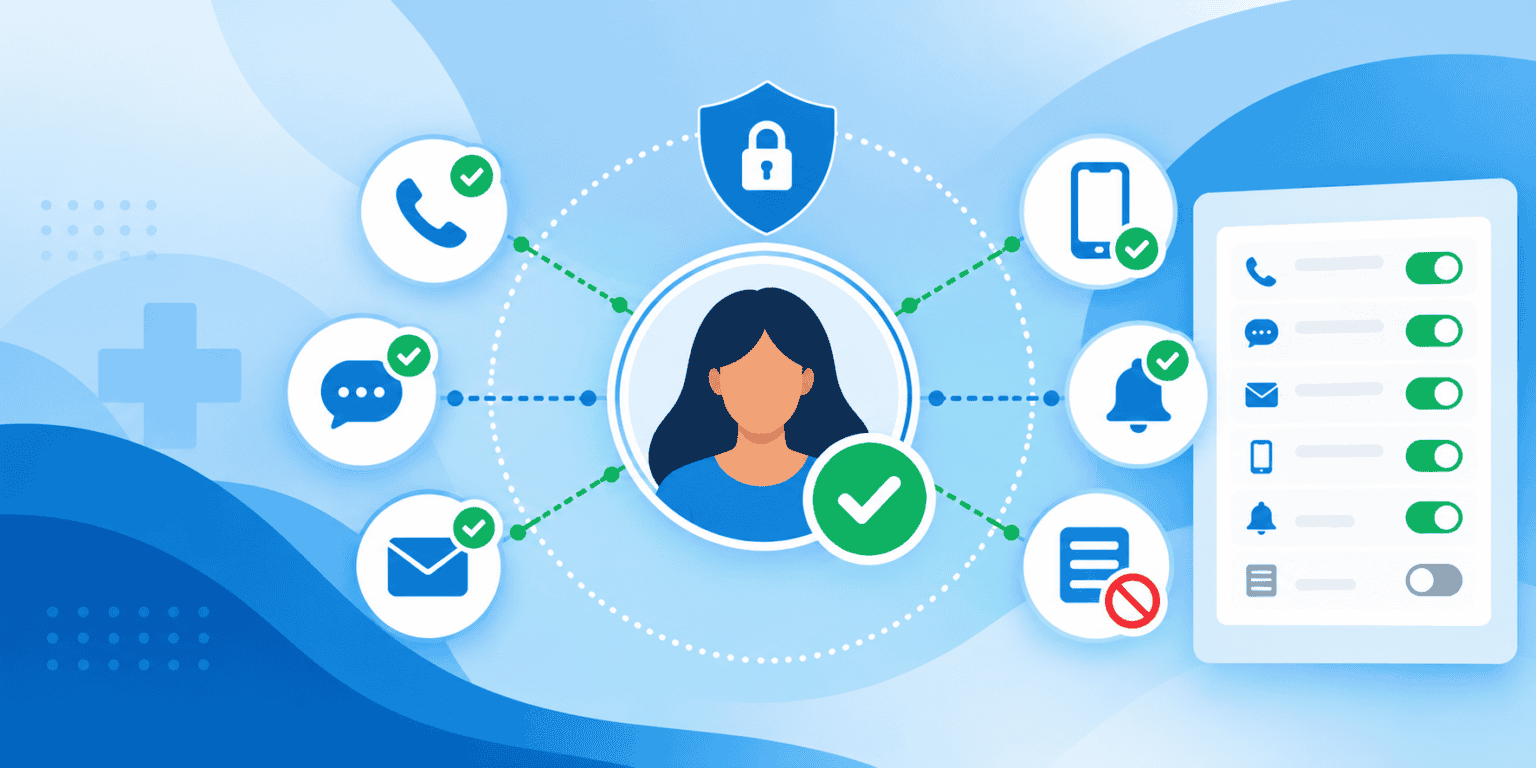
- Member consent management is the operational discipline of capturing, storing, enforcing, and proving member contact preferences across every channel and program a Healthcare Payer runs.
- Most Payers hold the consent they need but cannot enforce it consistently or prove it later, because consent lives in one system while the campaign runs in another.
- A marketing opt-out does not necessarily end care-related servicing contact, but a Payer can act on that distinction only if it captured the scope of the opt-out when the member made it.
- Unified enforcement means one authoritative consent record that every outreach system checks before contact, updates in real time, and writes to an immutable audit trail.
Member consent management is the operational discipline of capturing, storing, enforcing, and proving member contact preferences across every channel and program a Healthcare Payer runs. The problem is rarely a missing policy. Most Payers hold the consent they need but cannot enforce it consistently or prove it later, and the same fragmentation that creates that exposure also causes Payers to suppress members they are legally free to contact. This guide covers how a Payer operationalizes consent rather than what the rules require.
Table of Contents
- What Does Member Consent Management Actually Involve?
- Where Member Consent and Preferences Get Captured
- Why Consent Fragments Across Healthcare Payer Systems
- What Does Over-Suppression Cost Healthcare Payers?
- What Unified Consent Enforcement Looks Like in Practice
- Agentic Outreach Governance: The Next Consent Challenge
- Making Member Consent an Asset, Not a Constraint
- Frequently Asked Questions
What Does Member Consent Management Actually Involve?
Member consent management involves four continuous responsibilities. A Payer must capture consent at every member touchpoint, store it with enough detail to be defensible, enforce it in real time at the point of contact, and produce proof of it on demand. Most Payers handle capture well and the other three inconsistently.
The 4 Stages: Capture, Store, Enforce, Prove
The discipline breaks into four stages, and each depends on the one before it. Capture records what a member agreed to. Store preserves that agreement with enough context to defend it. Enforce applies it at the moment of every contact. Prove reconstructs it on demand. Payers typically break at enforce and prove, not at capture, which is why holding valid consent and honoring it reliably are two different things.
- Record consent and preferences at every touchpoint, across every channel.
- Preserve each record with timestamp, method, scope, and disclosure version.
- Check consent for this member, this channel, and this purpose before every contact.
- Reconstruct the consent state that existed at the time of any past contact.
This four-stage model is the reference point for the rest of this guide.
Why Consent Is a Data Problem, Not a Policy Problem
Consent failures at Healthcare Payers are rarely policy failures. The policy is usually correct and well documented. The real failure is that consent lives in one system while the campaign runs in another, so a preference the Payer legitimately holds never reaches the system placing the call. Solving it is an integration and enforcement problem, not a matter of rewriting policy, and that distinction determines which fixes work.
Where Member Consent and Preferences Get Captured
Consent and preference signals enter a Healthcare Payer through at least six channels, and most are owned by different teams and stored in different systems. They include enrollment and application forms, the member portal, IVR interactions, agent-collected consent, mailed forms, and broker or third-party enrollment. Each capture point is only as useful as the record it leaves behind.
Capture Points Across the Member Journey
Consent enters across the full member journey, and each channel carries its own reliability profile. The strength of a consent program depends on how cleanly it records the weakest of these.
- Enrollment and application forms. Structured and authoritative, but frozen at a single point in time.
- Member portal. Current and member-driven, but only as good as the preference fields it offers.
- IVR interactions. Immediate, but often logged without the exact language presented.
- Agent-collected consent. Flexible, but dependent on the agent recording scope accurately.
- Mailed forms. Documentary, but slow and frequently keyed in by hand.
- Broker and third-party enrollment. Necessary, but captured outside the Payer’s direct control.
The care taken at each of these points determines how defensible the record is later. For the mechanics of obtaining valid consent at these touchpoints, the standards matter as much as the channel.
What a Defensible Consent Record Contains
A defensible consent record contains far more than a yes-or-no flag. It captures the timestamp, the capture method, the exact language presented, the scope of what was agreed to, the channels covered, the identity of whoever captured it, and the version of the disclosure shown. In TCPA litigation, the burden of proving consent sits with the caller, so a record missing any of these fields may not hold.
- When consent was captured.
- Capture method. How it was collected, such as portal, IVR, agent, or form.
- Exact language presented. The wording the member actually saw or heard.
- Which message types and purposes the member agreed to.
- Channels covered. Voice, text, email, or mail.
- Captured by. The person or system that recorded it.
- Disclosure version. Which version of the disclosure was shown at the time.
Channel- and Purpose-Level Preference Granularity
A single opt-in or opt-out flag is not enough for a Healthcare Payer. A member may want appointment reminders by text, benefits information by mail, and no marketing contact at all. Granular preference capture records consent separately by channel and by purpose, so the Payer can honor each choice independently rather than collapsing them into one all-or-nothing switch. Coarse capture is what forces Payers into over-suppression later, because a system that stored only “opted out” has no way to know the member still wanted clinical reminders.
Why Consent Fragments Across Healthcare Payer Systems
Consent fragments because Healthcare Payers run outreach from multiple systems owned by multiple teams, often with vendors involved, and no single system holds the authoritative record. Three fracture points cause most of the damage. Program silos trap preferences inside one workflow, vendor chains break the propagation of opt-outs, and a timing gap opens between when a member opts out and when the systems actually stop.
Program Silos and Duplicate Member Records
Enrollment, care management, billing, and retention typically run their own contact workflows on their own member lists. A preference recorded in one is invisible to the others. The problem compounds when the same member appears under multiple identifiers, because a suppression applied to one record leaves the duplicate records live and contactable. This is the same fragmentation described in Gryphon’s analysis of compliance risks across decentralized Healthcare operations, where the violation emerges from the seams between systems.
Vendor and Business Associate Chains
Outreach conducted by a vendor on the Payer’s behalf creates exposure for the Payer, and any opt-out a vendor receives must reach the Payer’s own suppression records. Contractual language assigning responsibility does not prevent liability, a point reinforced by HHS guidance on business associates. The practical failure is that most Payers cannot demonstrate that a member’s opt-out propagated to every vendor within the required window.
The Gap Between Opt-Out Receipt and Enforcement
Liability attaches in the interval between a member asking to stop and the systems actually stopping. Batch synchronization, manual queues, and cross-team handoffs all widen that interval, and the 10-business-day processing requirement compresses the tolerance for it. For the full regulatory detail behind these obligations, see our companion guide to TCPA, DNC, and TSR requirements for member outreach and Gryphon’s explainer on consent revocation requirements.
What Does Over-Suppression Cost Healthcare Payers?
When a Payer cannot tell precisely what a member consented to, it suppresses defensively, and defensive suppression removes members the Payer is legally permitted and often clinically obligated to reach. The cost runs in both directions. Under-suppression creates compliance risk, while over-suppression quietly erodes quality measures, member experience, and revenue on both sides of the ledger.
It works against revenue maintenance by silencing the retention and renewal outreach that keeps existing members enrolled, and against revenue growth by cutting off the re-engagement and cross-program outreach that expands the relationship. It also degrades the member experience, because a member who wanted to hear from their Healthcare Payer is met with silence that reads as neglect rather than the caution it actually is.
How Blanket Suppression Removes Contactable Members
The mechanism is simple. A member opts out of one message type, the Payer lacks granular records, so the safest action is to suppress the member entirely. That member is now unreachable for care gap closure, medication adherence, and renewal outreach, which feeds directly into lower quality scores and Star Ratings. Gryphon data indicates that organizations may be avoiding contact with 25% to 45% of their legally contactable audience because of fragmented data and overly cautious suppression logic, and for a Healthcare Payer that lost population maps straight onto missed quality and retention outreach.
Separating Marketing Opt-Outs From Care-Related Contact
A marketing opt-out does not necessarily terminate a Payer’s ability to send care-related servicing communications. Regulators have recognized that members may want to stop promotional contact while continuing to receive transactional and clinical messages, a distinction that CMS draws in its Medicare Communications and Marketing Guidelines between marketing and non-marketing communications. Capturing that distinction at the point of opt-out is what makes it usable later, because a Payer cannot honor a preference it never recorded.
What Unified Consent Enforcement Looks Like in Practice
Unified enforcement means one authoritative consent record that every outreach system checks before contact, updates in real time, and writes to an immutable audit trail. The outcome is a single source of truth that no campaign, channel, or vendor can bypass. Real-time checks, cross-channel propagation, and point-in-time audit records are the three components that produce it, and each maps to a stage in the capture-store-enforce-prove model. This is the core of unified consent management for Healthcare Payers.
Real-Time Consent Checks at the Point of Contact
A real-time check evaluates consent status for this member, this channel, and this message purpose at the moment of dialing rather than at list-build time. The distinction matters because a list built Monday and dialed Thursday carries three days of stale consent state, during which members may have opted out, changed preferences, or had numbers reassigned. Moving the check to the point of contact is what real-time contact compliance is built to do.
Propagating Revocation Across Channels and Vendors
An opt-out received on any channel must apply across all channels and reach every downstream system and vendor automatically. This propagation is the hardest part of the problem for large Payers, because it requires every system to read from a single source of truth rather than maintain its own copy. Gryphon enforces this by treating consent as one shared record that updates everywhere the instant a member opts out, so a suppression captured in one channel is honored in all of them without a synchronization delay.
Building an Audit-Ready Consent Trail
An audit-ready trail must show what consent existed at the moment of each contact, not what consent exists today. Point-in-time reconstruction is the standard, because a dispute turns on the state of consent when the call was made, not its current value. Systems that overwrite consent state each time it changes cannot meet that standard, since they retain only the latest version. Building a fully auditable contact governance trail means preserving every prior state, not just the newest one.
Agentic Outreach Governance: The Next Consent Challenge
Agentic outreach governance is the set of controls that determine what an autonomous AI system is permitted to do when it initiates member contact, including who it may contact, on what basis, and under what constraints. It is an emerging discipline, and unified consent infrastructure is its foundation. Payers exploring AI-empowered member engagement will find that the consent groundwork comes first.
Why AI-Initiated Contact Raises the Consent Bar
AI-generated voice is treated as artificial or prerecorded voice under the TCPA following the FCC’s February 2024 declaratory ruling, which places AI-initiated calls in the strictest consent tier regardless of how human the voice sounds. A growing number of states, including Utah and California, have layered AI-disclosure obligations on top, each with its own trigger. (State AI-disclosure law is moving quickly. This reflects the landscape as of August 2026 and should be verified before publication.)
What Governance Looks Like for Autonomous Outreach
Governance for autonomous outreach spans five control categories. Consent must be verified before the agent initiates contact, scope constraints must limit what the agent may discuss, in-call enforcement must operate in real time, disclosure obligations must be met, and a complete record of what the agent said must be retained. The through-line is straightforward. An autonomous system can only respect a consent boundary that exists in a system it can query, so Payers that have not unified consent cannot govern agentic outreach.
Making Member Consent an Asset, Not a Constraint
Consent management is usually treated as a restriction on outreach, when precise consent data is exactly what allows a Payer to expand outreach safely. Payers with granular, unified, and provable consent contact more members, not fewer, because they can tell reachable members apart from restricted ones instead of suppressing both. Gryphon serves as the enforcement layer that makes this possible, with real-time verification, cross-channel propagation, and an audit trail that holds under scrutiny. The result is measured in contactability, not just risk avoided.
See how Gryphon helps Healthcare Payers unify member consent across every outreach channel. Explore Gryphon for Healthcare.
Frequently Asked Questions
What is member consent management for Healthcare Payer?
It is the operational discipline of capturing member contact preferences at every touchpoint, storing them in a defensible record, enforcing them in real time across all outreach systems, and proving what consent existed at the time of any given contact. Capture is usually solid; enforcement and proof are where Payers fall short.
Does a marketing opt-out stop all communication from a Healthcare Payer?
Not necessarily. Members frequently want to stop promotional contact while continuing to receive care-related and servicing messages. Whether a Payer can act on their marketing, sales, servicing, or collections outreach depends entirely on whether its systems captured the scope of the opt-out at the moment the member made it.
Who is responsible when a vendor fails to honor a member opt-out?
The Healthcare Payer retains exposure for outreach conducted on its behalf. Contractual allocation of responsibility does not eliminate liability, which makes propagation of opt-outs to every downstream vendor an operational requirement rather than a contractual one.
How long should a Healthcare Payer retain member consent records?
Retention should at minimum cover the Payer’s exposure window, which is generally tied to the TCPA’s four-year statute of limitations and often longer. The record must support point-in-time reconstruction of the consent that existed when a disputed contact was made, not merely the current state. Confirm the applicable period with counsel.
Can AI agents contact Healthcare Payer members?
Yes, subject to the same consent rules as any automated outreach. Following the FCC’s February 2024 ruling treating AI-generated voice as artificial or prerecorded voice, AI-initiated calls fall in the strictest consent tier, and several states add separate AI-disclosure requirements.
What is agentic outreach governance?
It is the set of controls that determine what an autonomous AI system may do when initiating member contact, including whom it may reach, on what consent basis, what it may discuss, and what record it must produce. Unified consent data is the prerequisite for all of it.
Related Posts
Key Takeaways: Member consent management is the operational discipline of capturing, storing, enforcing, and proving member contact preferences across every channel and program a Healthcare Payer runs. Most Payers hold…
Key Takeaways: Compliance audit readiness means being able to prove that every member and patient interaction was permissible on demand, not just sampling a small percentage of contacts after the…
Key Takeaways: Over-compliance is a hidden revenue problem: Healthcare Providers, Systems and Payers routinely block up to 40% of the members and patients they are legally permitted to contact, shrinking…