

October delivered the long-awaited replacement for the FCC’s “revoke all” rule, more Robocall Mitigation Database removals, and a fresh push in Congress to bring back one-to-one consent. Courts kept splitting on whether texts are calls, seven-figure settlements continued to follow missed stop requests, and states pressed ahead with their own telemarketing and AI rules. Here is what compliance leaders need to know.
Reminders
Federal Updates
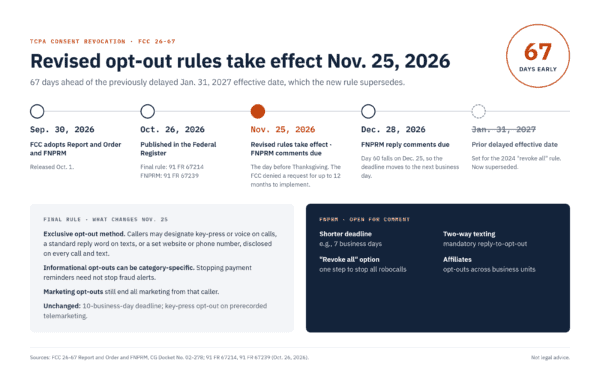
FCC’s New TCPA Opt Out Rules Take Effect November 25 – FNPRM Comments Due Same Day
Effective November 25. On September 30, the FCC unanimously adopted a Report and Order and FNPRM (FCC 26-67, CG Docket 02-278) that replaces the 2024 “revoke all” rule. The order was released October 1 and tracks the September draft we covered last month, with a few clarifications worth knowing.
What changed:
- Informational opt-outs can be category-specific. A “STOP” to a payment reminder no longer has to kill fraud alerts, MFA codes, or appointment reminders. The change is optional, and the order doesn’t define “category,” so callers need defensible, documented category lines.
- Marketing stays all-or-nothing. An opt-out from any telemarketing message still revokes consent for all future telemarketing from that caller, and from affiliates the consumer would reasonably expect to be included.
- Exclusive opt-out methods are allowed. Callers can designate IVR/keypress, standardized reply keywords, or a designated website or phone number, and ignore requests made other ways, as long as the method is clearly and conspicuously disclosed on every call or text.
- “Reply STOP” is enough, but all seven keywords still count. A text can list one keyword if the sender honors stop, quit, end, revoke, opt out, cancel, and unsubscribe.
- Other agencies’ opt-out methods don’t satisfy the TCPA. A caller that also follows another regulator’s opt-out rules, such as a debt collector under the CFPB’s Regulation F, can’t use that method as its TCPA opt-out channel. To limit opt-outs to one channel, it must use one of the three methods the FCC approved.
- Fraud-alert exemption widens. Banks and credit unions can now reach wireless numbers from a “reliable source” (an authorized family member, caller ID captured on an inbound call, another institution’s records), not just numbers the customer provided.
What didn’t change: the 10-business-day processing window, the “reasonable means” fallback for callers that don’t designate a method, and the automated opt-out requirement on prerecorded and artificial-voice calls, including AI voice.
Timing. The new rules take effect November 25, 2026, 30 days after Federal Register publication and more than two months ahead of the delayed January 31, 2027 “revoke all” date, which they supersede. The FCC rejected a request for up to 12 months to implement.
Industry got what it asked for. In a September 22 ex parte, the Edison Electric Institute “strongly” backed category-specific revocation and exclusive opt-out channels, warning that stopping one type of message could cut customers off from outage and emergency notices. The final order cites EEI along with ABA, ACA, and NCLC.
The FNPRM is the next step. Comments are due November 25, replies December 28. The FCC asks whether to:
- Cut the processing window from 10 business days to 7.
- Require two-way texting so reply-based opt-outs always work.
- Condition category-specific opt-outs on also offering a one-step “revoke all” option.
- Treat separately branded affiliates and divisions as separate callers.
- Apply a revocation only to the number that received it, not every number on the account (an EEI request).
- Allow a confirmation text asking which category the consumer meant to stop.
The flexibility only pays off if your systems can prove it. Map every message stream to a category, record which category each opt-out came from, push it to every vendor, and confirm all seven keywords are honored. Callers in financial services, healthcare, utilities, and collections should weigh in by November 25 on the 7-day window and mandatory “revoke all” proposals.
RMD: Tougher Rules, Faster Removals, and a Fight Over Who Gets Blocked
An accurate Robocall Mitigation Database (RMD) filing is now a condition of staying connected to U.S. networks. October brought two more removals and the next round in the FCC’s RMD overhaul.
The overhaul: replies due November 9. Initial comments on the RMD FNPRM (FCC 26-49), which we covered in September, closed October 9. The proposal would widen who must file, require “affirmative, effective measures” against illegal calls, demand far more ownership and KYC/KYUP disclosure, and screen new filers, possibly with letters of credit. Community banks have already asked the FCC to make sure they can issue those letters.
Digital Solutions cut off. On October 5, the FCC cut off Digital Solutions, Inc., a Denver-based provider, giving U.S. providers 30 days to block its traffic. The Industry Traceback Group had traced loan and IRS-relief robocalls to the company, and it never cured the RMD deficiencies the FCC flagged, as Mac Murray & Shuster lays out.
Mexico IP Phone cut off. On October 16, the FCC cut off Mexico IP Phone, giving providers just two days to block. The company submitted a falsified FCC document to get direct access to U.S. numbers and hid a State AG Task Force investigation from its RMD certification. RMD removals since January 2025 now exceed 1,400.
ClearCaptions: legitimate calls are getting flagged. Not everyone’s problem is too little blocking. In an October 8 ex parte, IP captioned telephone provider ClearCaptions told FCC officials that analytics firms used by carriers appear to be flagging calls from its new customers, whose average age is 80, as spam or fraud. It echoes the FCC’s own consumer advisory committee, which flagged false positives for critical medical and financial calls.
Two lessons for callers, not just carriers. First, your providers’ RMD status is now a business-continuity risk: a removal can cut a route in two days. Second, legitimate traffic gets blocked too. Keep caller ID registrations, branded calling, and number reputation current, and watch the November 9 reply round for how the FCC balances blocking against false positives.
KYUP: Carve-Out Requests and Pushback Build Before Final Rules
The FCC’s Know-Your-Upstream-Provider FNPRM (FCC 26-32, adopted May 20) would require every provider to collect, verify, and monitor information about the providers that hand them traffic, and to cut off bad actors. It also moves STIR/SHAKEN attestation decisions to the provider with the direct end-user relationship. Formal comments closed in September, but ex partes are still shaping the outcome.
- IPtelX and DICE want alarm-monitoring calls treated as public-safety calls. In an October 14 ex parte, they said short, high-volume alarm verification calls often get flagged as spam, forcing monitoring centers to dispatch police to what are usually false alarms. They ask the FCC to protect calls from vetted monitoring centers with verified identity, and to exempt alarm traffic from the proposed mandate to block unsigned calls.
- Pinger pushes back across three rulemakings. In a September 18 ex parte on a meeting with Commissioner Gomez’s office, Pinger addressed the KYUP, RMD, and related robocall proceedings together. Its three asks:
- Let the provider that serves the end user and holds its own SPC token make the attestation decision, and bar downstream providers from downgrading it.
- Define “facilities-based” before attaching attestation and self-classification consequences to it.
- Cut providers off only through notice, a chance to cure, and FCC-mediated RMD removal. Below that, blocking should rest on objective evidence tied to a specific number or traffic pattern, never on a provider’s business model.
Both filings make the same point from different sides. Legitimate high-volume callers get caught in blocking built for bad actors. Verified identity, not attestation level alone, is becoming the currency of deliverability.
Congress: Stop Spam Calls Act Would Revive One-to-One Consent (H.R. 10610)
One-to-one consent is back on the table. On September 24, Reps. Suhas Subramanyam (D-VA) and Jefferson Shreve (R-IN) introduced the bipartisan Stop Spam Calls Act, H.R. 10610, referred to House Energy and Commerce. Reps. Krishnamoorthi, Carson, Whitesides, and Mannion cosponsored the bill.
What it would do:
- Direct the FCC, within one year, to rewrite the definition of “prior express written consent” (47 CFR 64.1200(f)(9)) to read exactly as it did in the FCC’s January 26, 2024 “Targeting and Eliminating Unlawful Text Messages” final rule.
- That restores the one-to-one framework: consent to no more than one identified seller at a time, with calls and texts logically and topically associated with the interaction that prompted consent.
- The revised definition would take effect 18 months after enactment.
- It protects the FCC’s existing authority. The bill states that it shouldn’t be read to suggest the FCC lacked the power to require written consent before the bill passed.
The Eleventh Circuit vacated the one-to-one rule in January 2025, before it took effect. The bill is endorsed by NCLC, NCL, NACA, CFA, and Consumer Action, and the sponsors frame it as closing the single-checkbox loophole that lets one form authorize calls from thousands of marketing partners.
Defense-side commentators expect a tough road, noting that post-McLaughlin courts can disregard FCC regulations in favor of the statute’s plain text, and the Fifth Circuit has already held the FCC’s written-consent requirement unenforceable. A bill that only directs a CFR rewrite may not bind courts the way a statutory amendment would.
If one-to-one returns, programs that rely on lead generation will need consent that names one specific seller and calls that relate to what the consumer originally asked about.
Foreign Robocall Elimination Act (H.R. 6152) Heads for the Floor
H.R. 6152, led by Rep. Addison McDowell (R-NC) and Rep. Kelly Morrison (D-MN), keeps adding support. After a September 1 subcommittee voice vote, the full Energy and Commerce Committee reported the bill 37-0 on September 16. McDowell said he looks forward to getting it across the House floor.
- Creates an FCC-led interagency task force on foreign-originated robocalls, with a report to Congress.
- Strengthens traceback, including liability protection for the registered traceback consortium.
- Allows an FCC rulemaking on a bond for RMD filers to raise the cost of entry for bad actors.
- The Senate version, S. 2666, passed by unanimous consent on August 3 and is held at the desk in the House. It makes the bond and RMD registration mandatory.
The bill now has 39 cosponsors (21 Republicans, 18 Democrats), up from 38 at our September report. The newest is Rep. Eric Sorensen (D-IL), who joined October 6.
Do Not Call Act (H.R. 6449): Quiet, but Not Dead
The bipartisan Do Not Call Act, introduced December 4, 2025, by Reps. David Kustoff (R-TN) and Deborah Ross (D-NC), has barely moved since it was referred to House Energy and Commerce. But it just picked up a new cosponsor: Rep. Johnny Olszewski (D-MD) joined October 1, bringing the total to 14 (11 Democrats, 3 Republicans). Sen. Catherine Cortez Masto (D-NV) leads the Senate companion. Key provisions:
- Criminal exposure. Willful and knowing violations of Section 227 could bring up to 1 year in prison. That reaches DNC rules and SMS programs, not just scam robocalls.
- Aggravated offenses up to 3 years. These cover repeat convictions; volumes over 100,000 calls in 24 hours, 1 million in 30 days, or 10 million in a year; calls made to further a felony; and losses of $5,000 or more in a year. High-volume contact centers could hit the volume thresholds on their own.
- “Initiate” includes transmitting. That could reach vendors and platforms in the calling chain, not just the business placing the call.
Criminal liability turns on proving willful and knowing violations, so documented consent and suppression records become your best defense.
State Watch
States Step Up: Florida, Michigan, and a Push to Keep AI Authority Local
State attorneys general are moving faster than Congress. Florida AG James Uthmeier proposed the Florida Anti-Spam Communications Act on September 17. It would give his office direct power to pursue unwanted calls and texts, create felonies for spoofing, undisclosed AI voices, and SIM farms, require carriers to respond to tracebacks, and tighten how quickly “STOP” requests must be honored.
In Michigan, HB 6393, introduced September 24, would add TCPA-style rules covering consent for autodialed and prerecorded calls, revocation, 8 a.m. to 9 p.m. calling hours, DNC, spoofing, and AI-voice disclosures.
On AI, 26 AGs urged Congress to pass federal rules that don’t preempt state laws. States aren’t waiting: Illinois, California, New York, and Connecticut have already passed their own AI safety laws, and state bank regulators released an AI supervisory framework.
Case Watch
Are Texts Calls? A Florida Court Goes Further: No Private Right of Action for DNC Claims
See our interactive Judicial Ruling tracker on this subject here.
The text-message split keeps widening, and a Florida ruling opened a new front. In a DNC text case against MortgagePros, LLC, the Middle District of Florida agreed that texts are not “calls” under most FCC regulations. More striking, the court held the national DNC regulations were adopted under the Do-Not-Call Implementation Act of 2003, not the TCPA, so the TCPA’s private right of action does not reach them. Defense counsel Klein Moynihan Turco says no court had been presented with that argument before. If it spreads, the “no PRA” theory would hit the core of DNC litigation, which drives most federal TCPA filings.
More courts follow Steidinger. Beyond Anthony and Card, which we covered in September, more district courts have held that texts fall outside Section 227(c)(5):
- Conrad v. Hart Consumer Products (M.D. Ala. Sept. 16, 2026)
- Rush v. SelectQuote Insurance Services (W.D. Mo. July 30, 2026)
But not everywhere. In Miller v. S. Brown & Associates, the Central District of California held a text is a call under Section 227(c)(5), reasoning that following Steidinger would mean rejecting binding Ninth Circuit precedent. The cases it relied on addressed Section 227(b), a distinction the court did not take up.
Forum matters, and nothing is settled until the Supreme Court weighs in. Texting programs that run nationally should keep complying as if texts are calls and DNC claims are live. Treat favorable rulings as litigation defenses, not compliance permission. State mini-TCPAs also cover texts regardless of how this split resolves.
TCPA Roundup: Stop Requests, Wrong Numbers, and AI Voices
Texts sent after a “STOP” and prerecorded calls to wrong numbers keep producing seven-figure settlements:
- Teleflora agreed to pay $6 million over promotional texts to numbers on the National DNC Registry, up to about $251 per number. The final approval hearing is November 25.
- Coast Dental agreed to pay up to $3.84 million in cash or toothbrush vouchers over appointment-reminder texts sent after recipients asked to stop.
- Palm Beach Tan agreed to pay $2.5 million over texts sent after “STOP” requests.
- Aidvantage, the student loan servicer, agreed to pay $3 million over prerecorded calls to people with no account.
- Molina Healthcare won final approval of a $1.93 million settlement over prerecorded calls to numbers it had already logged as wrong numbers.
New suits and rulings to watch:
- A card issuer faces Rosenthal Act and TCPA claims for calling for months after a verbal request to stop, including from new numbers after the consumer blocked the old ones.
- A car dealer is being sued in Massachusetts federal court after an AI-voiced prerecorded message reached a wrong number. The FCC treats AI voices as “artificial voice” under the TCPA.
- A Pennsylvania federal judge dismissed a proposed class action over NRCC fundraising texts, reasoning the recipient could have used FCC-approved methods to stop them himself.
Most of these cases trace back to the same gaps: stop requests that never reached every system, and numbers that were never checked for reassignment.
Washington’s CEMA: Email Spam Suits Keep Coming as Texts Become Scammers’ Top Entry Point
Texts now nearly match email as the way scams start: since September 2025, SMS-initiated scams rose 35% while email-initiated scams fell 30%. Still, email litigation isn’t slowing. More than 200 class actions under Washington’s Commercial Electronic Mail Act (CEMA) target misleading subject lines like “last chance” or “40% off,” even after a 2026 amendment cut statutory damages from $500 to $100 and added a knowledge requirement. In state court, Nike lost its bid to end one and is seeking an immediate appeal on whether plaintiffs must show real injury. In federal court, suits against Home Depot, Keurig, and others are paused until the Ninth Circuit rules on standing, while Macy’s and Audible were sent back to state court. Separately, a Texas collector faces an FDCPA class action for emailing a consumer 10 days after she texted “Stop.”
Audit subject lines for urgency or discount claims you can’t back up. And until courts settle how far a “Stop” reaches, consider honoring opt-outs across channels, especially in collections.
Jury to Decide Liability in FTC Ringless Voicemail Debt Relief Case
On October 15, Chief Judge Cynthia Bashant of the Southern District of California ruled that a jury will decide liability in USA v. Stratics Networks Inc. et al. (No. 3:23-cv-00313), filed on the FTC’s behalf. The 2023 suit alleges debt relief telemarketers used Stratics’ ringless voicemail service to send illegal robocalls for years. Defendants Ace Business Solutions and owner Sandra Barnes, who allegedly collected fees from enrolled consumers, wanted a bench trial before a judge alone.
- Why a jury: The FTC wants fines meant to punish, and the Constitution lets the government ask for a jury when punishment is on the table.
- Why it’s like fraud: The judge compared the claims, misleading people about a debt relief program through telemarketing, to traditional fraud cases.
- Who decides what: The jury decides whether the defendants broke the law. The judge decides how much they pay.
- What’s at stake: Nearly $23 million in fines across all defendants, including $3.43 million in fines plus $2.89 million in consumer refunds from Ace and Barnes.
Stratics itself won dismissal in 2024, and other defendants settled. Why it matters: Ringless voicemail drops are treated as telemarketing robocalls under the TSR, and companies further down the chain, like the one collecting enrollment fees, are still on the hook.
Court: The Fed Must Fund the CFPB Even When It Loses Money
A third federal judge has rejected the theory that the CFPB can’t draw Federal Reserve funding while the Fed runs at a loss. On September 25, in State of New York et al. v. Vought et al. (D. Or. No. 6:25-cv-02384), Judge Ann Aiken granted summary judgment to 22 states and D.C. She held that the Fed’s “combined earnings” means revenue before expenses, so CFPB funding doesn’t depend on Fed profitability.
Judge Aiken went further than the D.C. and California courts, finding then-acting director Russell Vought violated the separation of powers by refusing to request funding, and vacated his decisions. Those earlier rulings are on appeal, and nominee Brian Johnson awaits confirmation as permanent director.
Collections Corner
Autodialer and Prerecorded Voice Are Separate Fights
Two collection cases show the autodialer defense can be won, but prerecorded-voice claims need their own proof. In Nickson v. TrueAccord Corp. (D. Md.), the court granted summary judgment on the autodialer claim after vendor Solutions by Text documented that its platform doesn’t generate or store numbers. The court also held that collection texts aren’t solicitations for DNC purposes.
In Cruz v. United Collection Bureau (S.D. Cal.), the court tossed the autodialer theory but sent the prerecorded-voice question to a jury. The consumer described scripted calls that opened with a pause, and the collector couldn’t confirm what was played on every call. Keep vendor technical specifications and call recordings on file: they decide these cases.
Pro Se Plaintiffs Now Half the Docket
At NCBA’s 2026 Connect conference, one collection law firm said self-represented litigants now make up roughly half its caseload, with AI tools helping them file polished paperwork and same-day responses. TrueAccord also reported about 1,300 inbound texts a day that opt out without using a keyword like “stop,” a reminder that opt-out handling has to catch plain-language requests.
Canada: “Payment Is the Only Abort Code”
Consumer Protection BC fined Toledo Credit $34,000 for harassing and misleading collection practices, including a text that read, “Payment is the ONLY abort code. Financial annihilation imminent.” Aggressive text scripts draw enforcement on both sides of the border.
Text Gets Paid Faster
A Solutions by Text and Datos Insights survey of 2,000 consumers found more people prefer email for bills (37%) than text (24%). But texts drive faster payment: 34% paid the same day after a text, versus 24% after an email. For collection accounts, the gap narrows to 24% versus 21%.
Voice AI Rollouts: Guardrails, Hang-Ups, and Handoffs
Intermountain Health and Mutual of Omaha Mortgage shared lessons from their voice AI rollouts that apply directly to collections: start with rules-based tasks, build guardrails against drift and hallucinations, and hand off to a person quickly. Some consumers hang up as soon as they learn they’re talking to AI.
NYC SHIELD Rule: Regulators Answer Industry Questions
At an October 5 webinar, NYC’s Department of Consumer and Worker Protection answered industry questions ahead of the SHIELD rule’s January 1, 2027 effective date. DCWP also posted its DCWP 101 webinar on the rule. Key clarifications:
- The limit of three communications in seven days applies per account, not per phone number, and mail doesn’t count.
- Validation notices must go by mail or courier. Email is allowed only with E-SIGN consent.
- Notices must name a real employee, and callback numbers must reach a live person.
Quick Takes
FCC: “Zero Plans” to Loosen Political Robocall Rules
Following up on our September report: the FCC says it has “zero plans” to act on Club for Growth’s petition to let AI-generated political robocalls reach cell phones without consent before the November 3 midterms. Replies closed October 19. Commissioner Gomez opposed the waiver, while the American Association of Political Consultants backed it on First Amendment grounds. An FCC spokesperson said the agency took comment only as routine procedure. The consent rules for political calls to cell phones stay in place.
21st Century FTC Act Returns
Rep. Kathy Castor (D-FL) reintroduced the 21st Century FTC Act (H.R. 10540), which would let the FTC write unfair-or-deceptive-practice rules through standard notice and comment and seek civil penalties for first-time violations of the FTC Act. With Democrats in the minority, it faces long odds, but it’s a marker for future FTC authority debates.
FCC Launches Consumer Blocking Guides at fcc.gov/blockit
On September 22, the FCC published five step-by-step guides at fcc.gov/blockit showing consumers how to turn on call and text blocking and filtering: one each for iPhone and Android, and one each for AT&T, T-Mobile, and Verizon (ConsumerAffairs). More consumers with filtering turned on means more legitimate calls risk being labeled or silenced. Branded caller ID and clean number reputation matter more, not less.
Consumer Litigation: August Mixed, 2025 Hit a 10-Year High
August consumer litigation was mixed, per WebRecon data reported by ACA International:
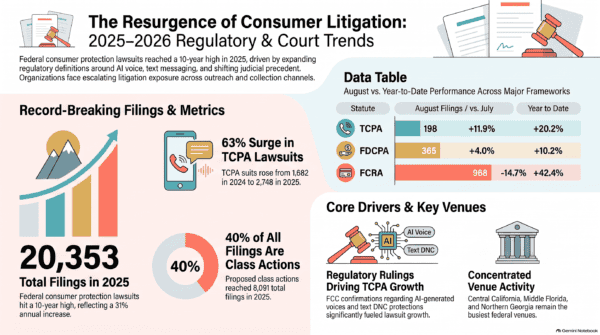
| Statute | August filings | vs. July | Class actions | Year to date |
|---|---|---|---|---|
| TCPA | 198 | +11.9% | 143 (72.2%) | +20.2% |
| FDCPA | 365 | +4.0% | 34 (9.3%) | +10.2% |
| FCRA | 968 | -14.7% | 11 (1.1%) | +42.4% |
The longer view is sharper. Lex Machina’s 2026 Consumer Protection Litigation Report found federal consumer protection filings hit a 10-year high of 20,353 in 2025, up 31% from 2024. FCRA and TCPA drove much of that growth:
- TCPA suits rose to 2,748 in 2025 from 1,682 in 2024. That’s still below the 2016 peak of 4,253, but a steady rebound since 2022.
- The report credits the rebound to the FCC confirming the TCPA covers AI-generated voices, the FCC’s 2024 move to codify DNC protections for texts, and McLaughlin, which freed courts from deferring to FCC interpretations.
- FCRA suits hit a decade high of 7,750, up 44%.
- Proposed class actions reached 8,091, about 40% of all consumer protection filings.
- More than 12,000 suits were filed in the first half of 2026, on pace to climb again.
The busiest venues were the Central District of California, the Middle District of Florida, and the Northern District of Georgia. Georgia’s 2024 telemarketing changes likely drove a 35% jump in filings there.
New York State of Emergency Issued Through November 8, 2026
Consistent with prior communications, Executive Orders declaring disaster emergencies in the State of New York trigger telemarketing restrictions under the Nuisance Call Act. The Nuisance Call Act makes it unlawful for any telemarketer to make unsolicited telemarketing sales calls to areas of the state under an emergency declaration.
Executive Order 47.23, declaring a State Disaster Emergency in the State of New York ordering into active service the New York National Guard to assist authorities in guaranteeing public order (correctional facilities), is in effect through November 8, 2026.
Executive Order 65, declaring a State Disaster Emergency in the State of New York due to an ongoing measles outbreak, is in effect through November 4, 2026.
Gryphon has extended State of Emergency blocks for New York to November 8, 2026, to ensure compliance with the above Executive Orders. Contact the Gryphon Helpdesk with any questions at 866-366-6822.
November 2026 Holiday Solicitation Bans
Please be aware of the following U.S. holiday telephone solicitation bans for the month of November 2026:
- On November 11, 2026, Alabama, Louisiana, Nebraska*, Pennsylvania, Rhode Island, and Utah prohibit unsolicited sales and marketing calls to residents in observance of Veterans Day.
- On November 26, 2026, Alabama, Louisiana, Nebraska*, Pennsylvania, Rhode Island, and Utah prohibit unsolicited sales and marketing calls to residents in observance of Thanksgiving Day.
- On November 27, 2026, Nebraska* and Pennsylvania prohibit unsolicited sales and marketing calls to residents in observance of Thanksgiving, Friday After Holiday.
Other holidays may be proclaimed by the Governor in each state throughout the year.
*Nebraska does not prohibit calls on Sundays or legal holidays; however, it does restrict the use of prerecorded messages to 1 p.m. to 9 p.m. on these days (subject to certain exceptions).
Please be aware of the following Canadian holiday telephone solicitation bans for the month of November 2026:
- On November 11, 2026, unsolicited sales and marketing calls to residents of the following provinces and territories are prohibited in observance of Remembrance Day: Alberta, British Columbia, New Brunswick, Northwest Territories, Nunavut, Prince Edward Island, Saskatchewan, and Yuko.
Gryphon has updated its existing service parameters to reflect these solicitation bans. Please contact us with any questions at 866-366-6822.
About Gryphon
Staying updated with the latest regulatory changes is crucial for any enterprise aiming to minimize risk and maximize reach.
With Gryphon, enterprises can stay ahead of the regulatory curve and efficiently manage all regulatory changes, ensuring seamless compliance and operational excellence.
To learn more about how Gryphon can help you manage these updates, reach out to us today.
This blog is provided for general informational and marketing purposes only and does not constitute legal advice. The information may reflect an interpretation of applicable laws and regulations as of the publication date and may not reflect subsequent changes. Laws and regulations vary by jurisdiction, and this content may not apply to your specific circumstances. Nothing in this blog should be relied upon as a substitute for legal advice, and we disclaim any liability for actions taken based on the content provided. Please consult qualified legal counsel for advice specific to your situation.